

How Nudge Theory Changes Consumer Decisions: The Boston Hospital Experiment That Reduced Soda Sales by 11%
In the modern economy, consumer decisions are rarely based solely on price, product quality, or rational evaluation. Instead, human behavior is strongly influenced by context, environment, and cognitive perception.
One of the most powerful concepts that explains this phenomenon is Nudge Theory, a principle rooted in behavioral economics.
Nudge Theory suggests that small changes in the environment where decisions are made can significantly influence human behavior without restricting freedom of choice.
Today, this concept is widely applied in:
-
Digital marketing
-
User experience design
-
Public policy
-
E-commerce platforms
-
Consumer psychology
For businesses and executives, understanding how behavioral economics shapes decisions can dramatically improve marketing effectiveness, customer engagement, and conversion rates.
In this article we explore:
-
What Nudge Theory is
-
The psychological foundations behind behavioral economics
-
The famous experiment conducted by Anne Thorndike at Massachusetts General Hospital
-
Kurt Lewin’s behavioral equation from 1936
-
The role of human perception and the nervous system in decision making
-
How businesses can apply these principles in digital marketing strategies
What Is Nudge Theory?
Nudge Theory is a concept within behavioral economics that explains how subtle changes in the way choices are presented can influence people’s decisions.
Instead of forcing people to make certain choices through regulations or restrictions, Nudge Theory works by designing environments that gently guide individuals toward better decisions.
The key idea is simple:
When the environment is designed carefully, people naturally tend to choose the most visible, convenient, or accessible option.
This principle has become extremely important in fields such as:
-
Marketing
-
Product design
-
Digital platforms
-
Public health initiatives
-
Behavioral policy design
In digital environments such as websites or applications, the way information is organized can strongly affect user decisions.
Scientific Foundations of Behavioral Influence
The concept that environment influences behavior did not originate in marketing. It has deep roots in psychology.
One of the most influential theories came from the psychologist Kurt Lewin, who proposed a behavioral model in 1936.
Kurt Lewin’s Behavioral Equation
In 1936, Kurt Lewin introduced a famous formula that explains human behavior:
B = f(P, E)
Where:
B = Behavior
P = Person
E = Environment
This equation means that human behavior is a function of both the individual and the surrounding environment.
In other words, people’s actions are shaped not only by their personality but also by the context in which they make decisions.
This idea later became a foundational concept for behavioral economics and Nudge Theory, emphasizing that altering the environment can influence behavior without changing the person.
The Boston Cafeteria Experiment
One of the most famous real-world demonstrations of Nudge Theory was conducted by Anne Thorndike, a physician and researcher at Massachusetts General Hospital in Boston.
The goal of the experiment was simple:
Encourage healthier beverage choices in the hospital cafeteria without banning soda or increasing prices.
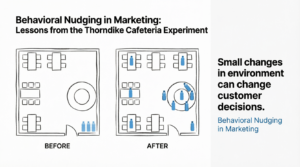

The Experiment Design
Instead of restricting soda sales, the researchers made small environmental changes to the cafeteria layout.
They simply rearranged the way beverages were displayed.
Key changes included:
-
Placing bottled water in highly visible locations
-
Positioning water near checkout counters
-
Increasing the number of locations where water was available
-
Keeping soda available but less prominently displayed
No products were removed. No pricing changes were introduced.
Only the environment was redesigned.
The Results
The results of the experiment were remarkable.
After implementing these subtle changes:
Soda sales decreased by 11.4 percent.
Meanwhile, bottled water purchases increased by 25.8 percent.
This dramatic shift in consumer behavior occurred without restricting choice or enforcing regulations.
The experiment demonstrated how environmental design can significantly influence decision-making.
Human Perception and Decision Making
To understand why Nudge Theory works, we must examine how the human brain processes information.
The human nervous system is an incredibly complex network responsible for interpreting sensory signals from the surrounding environment.
Scientists estimate that humans rely on approximately eleven million sensory receptors that collect information such as:
-
Light
-
Sound
-
Color
-
Movement
-
Spatial arrangement
-
Visual cues
These signals are processed by the brain to create perception, which ultimately shapes decisions.
This means that people do not always evaluate every option logically. Instead, their attention is directed by visual cues and environmental structure.
As a result, the way choices are presented can strongly influence outcomes.
Behavioral Economics and Digital Marketing
In the digital era, websites, applications, and online platforms act as the decision-making environments for consumers.
Every element of a digital interface can affect user behavior, including:
-
Product placement
-
Color schemes
-
Button design
-
Pricing presentation
-
Recommendation systems
Leading technology companies invest heavily in behavioral design to optimize user experience and increase conversions.
Digital marketing strategies increasingly rely on insights from behavioral economics to guide users toward desired actions.
Practical Applications of Nudge Theory in Digital Marketing
Businesses apply Nudge Theory in various ways to influence consumer behavior.
Product Positioning
Products placed at the top of a page or in highlighted sections receive more attention and higher purchase rates.
Default Options
Many platforms use pre-selected options to encourage certain behaviors, such as newsletter subscriptions or recommended plans.
Social Proof
Displaying messages such as:
“Most popular product”
or
“Customers also bought”
encourages users to follow the behavior of others.
Scarcity Signals
Limited availability messages like:
“Only 3 items left”
can increase urgency and accelerate purchase decisions.
Why Nudge Theory Matters for Businesses
In competitive digital markets, businesses must understand not only what consumers want but how they make decisions.
Companies that apply behavioral insights can achieve:
-
Higher conversion rates
-
Better user engagement
-
Improved customer experience
-
Stronger brand trust
Understanding behavioral economics allows businesses to design marketing strategies that align with natural human decision patterns.
Nudge Theory demonstrates that small environmental changes can produce significant behavioral shifts.
The experiment conducted by Anne Thorndike at Massachusetts General Hospital clearly illustrated this principle, showing that simple product placement adjustments reduced soda sales by 11.4 percent while increasing bottled water purchases by 25.8 percent.
Combined with Kurt Lewin’s behavioral equation, these findings highlight a fundamental insight:
Human behavior is shaped by both personal factors and environmental context.
In the digital world, this means that website design, marketing messages, and user experience can significantly influence customer decisions.
Businesses that integrate behavioral economics into their digital strategies will be better positioned to compete in the modern marketplace.
If your business wants to improve conversion rates and optimize customer experiences using behavioral insights and modern digital marketing strategies, the team at Wide Digital Marketing Agency can help.
Visit our website to learn how we help organizations build smarter digital marketing strategies.
FAQ
What is Nudge Theory?
Nudge Theory is a concept in behavioral economics that explains how small changes in the way choices are presented can influence people’s decisions without restricting their freedom.
What did Anne Thorndike’s experiment demonstrate?
Her study at Massachusetts General Hospital showed that simply changing beverage placement reduced soda sales by 11.4 percent and increased bottled water purchases by 25.8 percent.
How does behavioral economics relate to digital marketing?
Digital marketing uses behavioral insights to design websites, advertisements, and user experiences that guide consumers toward desired actions.