

How Users Actually Read Content: The F & Z Patterns and Their Impact on UX and Conversion
If you think users read your website content word by word, you’re building your strategy on a false assumption.
Reality—proven by eye-tracking studies—is that users don’t read… they scan.
This single fact explains:
- Low engagement
- High bounce rates
- Weak conversion performance
In modern digital marketing, especially with the rise of digital transformation in Saudi Arabia, understanding how users consume content is no longer optional.
How Users Process Digital Content
Users interact with content under time pressure and cognitive limits.
Cognitive Load
When a page is complex, users experience mental strain and respond by:
- Skipping large text blocks
- Searching for headings
- Jumping between sections
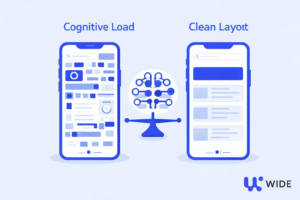
Reducing complexity improves comprehension and decision-making
The F-Pattern
The F-pattern is one of the most widely observed reading behaviors, especially in content-heavy pages.
How It Works
Users scan content in this shape:
- Horizontal line at the top
- Shorter horizontal line below
- Vertical scan down the left
Why It Happens
Users are searching for:
- Key information
- Headings
- Keywords
This is directly tied to user behavior.
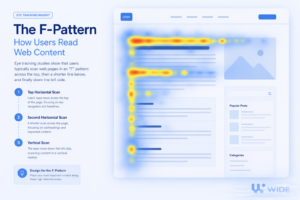
Users focus heavily on top content and left-aligned areas
How to Optimize for the F-Pattern
To align with this behavior:
- Place key information at the top
- Use clear headings
- Start paragraphs with strong phrases
- Use bullet points
This falls under user experience optimization.
The Z-Pattern
The Z-pattern appears in simpler layouts such as:
- Landing pages
- Homepages
- Service pages
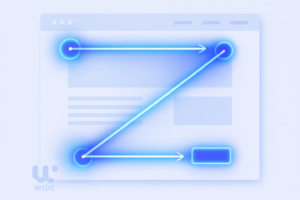
Users follow predictable visual paths when scanning simple layouts
How It Works
Users follow a Z-shaped path:
- Top left → right
- Diagonal down
- Bottom left → right
Why It Matters
It defines:
- Attention flow
- CTA placement
Impact on Conversion
If your layout ignores these patterns:
- Users get confused
- They lose focus
- They leave
But when aligned:
- Conversion rates improve
- Engagement increases
- Decisions happen faster
Visual Hierarchy
Visual hierarchy organizes elements to guide users.
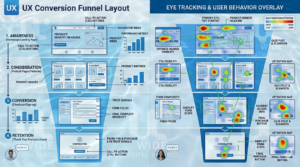
Structured layouts guide users toward action
Application in Saudi Arabia
With the growth of:
- Digital transformation
- Government digital services
- UX in public platforms
It is critical to design based on user behavior.
Common Mistakes
- Long paragraphs
- No headings
- Poor layout
- Misplaced CTA
- Cluttered design
Recommendations
- Design before writing
- Write for scanning, not reading
- Use F-pattern for content
- Use Z-pattern for conversion
- Test user behavior
Is your website designed for real user behavior… or assumptions?
At Wide, we build content and UX strategies based on real user behavior to increase engagement and conversions.
Start now:
https://wide.sa/about-us/contact-us/