

What Is Engagement in Digital Marketing and How Does It Drive Leads?
What Is Engagement in Digital Marketing and How Can It Turn Into Real Leads?
In digital marketing, visibility alone is not enough. A post can reach thousands of people, a video can get many views, and an ad can appear repeatedly in front of an audience, yet none of that guarantees business results. This is where engagement becomes important. Engagement shows how people respond to your content. It tells you whether your audience is simply seeing your message or actually interacting with it. A like, comment, share, save, click, message, profile visit, or website visit can all be forms of engagement depending on the platform and campaign objective. But for businesses, the real question is not only how much engagement a post receives. The more important question is: Does this engagement move people closer to becoming customers? Many companies celebrate likes and comments without asking whether those interactions come from the right audience or lead to website visits, inquiries, or sales opportunities. On the other hand, a post with fewer likes may generate stronger commercial results if it brings qualified users to a service page or encourages people to contact the business. This article explains what engagement means in digital marketing, how it differs from reach, views, clicks, and impressions, how engagement rate is calculated, and how businesses can turn social media engagement into real leads.What Is Engagement in Digital Marketing?
Engagement in digital marketing refers to any action a user takes in response to a piece of content or an advertisement. This can include liking a post, leaving a comment, sharing content, saving a post, clicking a link, watching a video, sending a message, visiting a profile, or interacting with a call-to-action button. In simple terms, engagement means that the user did more than just passively see the content. They reacted, interacted, or took a step. However, not all engagement has the same value. A like may indicate basic interest. A comment may show stronger involvement. A share may expand your reach to a new audience. A link click may show commercial intent. A direct message or form submission may indicate a real lead. For this reason, businesses should not treat every engagement as equal. One message from a potential client asking about your service can be more valuable than hundreds of casual likes from an audience that has no buying intent.Why Visibility Alone Is Not Enough
Visibility matters, but it is only the first step. If your content appears in front of 10,000 people, that does not necessarily mean those people understood your message, cared about your offer, or are interested in your service. Content can be seen without being noticed. It can be noticed without creating interest. It can create interest without driving action. And it can drive action only when the message, audience, and next step are aligned. That is why engagement is useful. It helps you understand whether your content is creating a meaningful response. Are people asking questions? Are they clicking the link? Are they saving the post? Are they sharing it with others? Are they visiting your website? Are they sending inquiries? These actions reveal whether your content is helping the audience move through the marketing journey.Real Engagement vs Surface-Level Engagement
Not every engagement is useful for business growth. Surface-level engagement includes actions that may look good in reports but do not necessarily create business value. For example, a post may receive many likes because it is funny, trendy, or visually appealing, but if it does not connect to your service or target audience, it may not generate leads. Real engagement is different. It shows actual interest or intent. Examples of meaningful engagement include: A user asking about your service. A user clicking a link to a service page. A user saving a post for later. A user sharing your content with a relevant audience. A user sending a direct message. A user visiting your contact page. A user requesting a consultation or quotation. For companies, the goal is not only to increase engagement. The goal is to increase the kind of engagement that supports awareness, trust, inquiries, and sales opportunities.Reach, Views, Clicks, Impressions, and Engagement: What Is the Difference?
One of the most common mistakes in social media reporting is mixing up reach, views, clicks, impressions, and engagement. These metrics are connected, but they do not measure the same thing.Reach
Reach is the number of unique people who saw your content at least once. If one person sees your post three times, reach still counts that person once. This metric helps you understand how many individual users were exposed to your content. Reach is important when your goal is brand awareness, but it does not tell you whether people interacted with the content or took action.Views
Views refer to the number of times a piece of content was viewed. This is especially common in video performance reporting. Views can be useful, but they need context. A video may have many views because it appeared automatically in users’ feeds, but that does not always mean people watched it carefully or were interested in the offer. For video content, watch time, completion rate, replays, and follow-up actions often provide deeper insight than views alone.Impressions
Impressions are the total number of times your content was displayed. Unlike reach, impressions can count the same user multiple times. For example, if one person sees your ad five times, that may count as one person reached but five impressions. Impressions are useful for understanding visibility and frequency, especially in paid campaigns.Clicks
Clicks show that a user took an action by pressing a link, button, image, profile, or other interactive element. For businesses, clicks are often more commercially meaningful than likes because they show movement from passive viewing to active interest. If the click leads to a service page, landing page, or contact page, it becomes even more valuable.Engagement
Engagement is the broader category. It can include likes, comments, shares, saves, clicks, messages, reactions, profile visits, and other actions depending on the platform. The key is not just counting engagement, but understanding what type of engagement you are getting and whether it supports your business objective.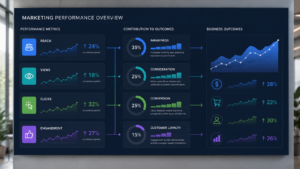
Reach, views, clicks, and engagement measure different stages of audience behavior, but their value increases when connected to business outcomes.
Which Metric Matters Most for Businesses?
The most important metric depends on the campaign goal. If the goal is brand awareness, reach and impressions matter. If the goal is website traffic, clicks and click-through rate matter. If the goal is community growth, comments, shares, and saves matter. If the goal is lead generation, messages, form submissions, contact requests, and qualified inquiries matter most. A strong performance report should not isolate one number. It should show the full journey: Did the content reach the right audience? Did the audience notice it? Did they interact with it? Did they click? Did they land on the right page? Did they contact the business? Did the inquiry become a sales opportunity? When you read the numbers in this sequence, engagement becomes a decision-making tool, not just a vanity metric.How Is Engagement Rate Calculated?
Engagement rate measures the percentage of users who interacted with your content compared to the number of people who saw or were reached by it. A common formula is: Engagement Rate = Total Engagements ÷ Total Reach × 100 For example, if a post received 300 engagements and reached 10,000 people, the engagement rate would be: 300 ÷ 10,000 × 100 = 3% This means that 3% of the people reached by the post interacted with it. However, different platforms may calculate engagement differently. Some include likes, comments, and shares. Others may include clicks, saves, video views, profile visits, or other platform-specific actions. That is why you should avoid comparing engagement rates across platforms without understanding how each platform defines engagement.When Should You Use Reach and When Should You Use Impressions?
If you want to understand how many unique people interacted with your content, use reach as the base. If you want to evaluate engagement compared to total exposure, use impressions. For example, engagement rate by reach helps you understand how relevant the content was to the audience that saw it. Engagement rate by impressions helps you understand how engagement performed against total content exposure, including repeated views. For business reporting, it is better to use multiple metrics together: Engagement rate by reach. Click-through rate by impressions. Cost per click. Cost per lead. Website visits from social media. Contact form submissions. Direct messages. Qualified inquiries. This gives a clearer view of performance beyond social media activity alone.Engagement Rate vs Click-Through Rate
Engagement rate measures all types of interaction. Click-through rate, also known as CTR, measures only clicks compared to impressions or views. A post can have a high engagement rate but a low CTR. For example, it may receive many likes and comments but only a few link clicks. On the other hand, an ad may receive fewer likes but generate many clicks to a service page. From a business perspective, the second ad may be more valuable if the objective is lead generation. This is why companies should not judge campaigns based only on visible interactions. They should also ask: How many people clicked? How many visited the website? How many reached the service page? How many contacted us? How many became qualified leads?Does High Engagement Always Mean Campaign Success?
Not always. High engagement can be a positive sign when it comes from the right audience and leads to a meaningful action. But it can be misleading if it comes from irrelevant users or from content that has no connection to your service. For example, a company may publish a general entertainment post and receive high engagement. But if no one visits the website, asks about the service, or remembers the brand in a buying context, the business value is limited. On the other hand, a more focused post that explains a customer problem and links to a service page may receive fewer likes but generate stronger inquiries. The goal is not to get the biggest number. The goal is to get the most useful number.When Is Engagement a Positive Signal?
Engagement is a positive signal when it helps the business move closer to a defined goal. It becomes valuable when it: Increases awareness among the right audience. Starts conversations around a relevant problem. Drives traffic to the website. Generates direct messages or inquiries. Builds trust in the brand. Supports paid campaigns. Improves understanding of customer questions and objections. When engagement supports one of these outcomes, it becomes part of business growth.When Can Engagement Be Misleading?
Engagement can be misleading when the numbers look strong but do not connect to commercial value. This happens when: The audience is outside the target market. The content is unrelated to the company’s service. Comments are general and not linked to real interest. Video views are high but watch time is weak. Clicks are high but users leave the website quickly. The campaign attracts unqualified traffic. The content creates attention but not demand. For this reason, engagement should always be analyzed in context.Why Businesses Need More Than Likes
Likes are easy to count, but they do not tell the full story. A business needs to know what happens after the like. Did the user visit the profile? Did they click the link? Did they read the article? Did they visit the service page? Did they send a message? Did they ask for pricing? Did they become a lead? Without this analysis, a company may continue producing content that gets attention but does not support sales. When engagement is connected to the customer journey, the business can identify which content deserves more investment and which platforms bring better leads.How Engagement Differs Across Social Media Platforms
Each social media platform has its own user behavior, content format, and engagement signals. A strong engagement metric on TikTok may not mean the same thing on Instagram, X, Snapchat, or LinkedIn. For businesses, the important question is not only how much engagement happened, but what that engagement means on each platform.Facebook and Instagram
On Facebook and Instagram, engagement can include likes, comments, shares, saves, story replies, profile visits, link clicks, and direct messages. For businesses, saves and shares may be more meaningful than likes because they show stronger intent. A save means the user found the content useful enough to return to it. A share means the user believed the content was relevant to someone else. For paid campaigns, the campaign objective matters. If the goal is website traffic, link clicks and landing page views are more important than likes. If the goal is messages, conversation quality becomes more important than public engagement.X
X is built around fast-moving conversations, short messages, and public reactions. Engagement may include likes, reposts, replies, quotes, link clicks, and profile visits. However, high engagement on X does not always mean commercial interest. Opinion-based or controversial posts may perform well but may not attract qualified leads. For service-based companies, X can be useful for thought leadership, sharing insights, promoting articles, and building credibility. In this context, link clicks, profile visits, and relevant conversations are more important than likes alone.TikTok
TikTok is driven by short-form video and fast content discovery. Engagement includes views, watch time, likes, comments, shares, saves, profile visits, follows, and link clicks when available. For TikTok, views alone are not enough. Watch time, completion rate, replays, and shares often reveal stronger content quality. For businesses, TikTok can be powerful for awareness and education. But if the video does not lead to a clear next step, such as visiting a profile, clicking a link, or contacting the company, the attention may not turn into business value.Snapchat
Snapchat is especially relevant in markets where users consume short, fast, visual content. Engagement can include video views, swipe-ups, taps, lens interactions, and website visits. For campaigns, swipe-up actions or website visits are often more valuable than views because they show that the user moved from watching to acting. Snapchat can work well for offers, events, local campaigns, awareness, and time-sensitive promotions, but the message must be direct and easy to understand.How to Turn Engagement Into Qualified Leads
Engagement does not automatically become leads. A company needs a clear path from content to action. That path usually includes four elements: Relevant content. A clear message. A strong next step. A page or channel ready to receive the user.Connect Content to a Clear Offer
The first step is making sure the audience understands what you offer. Many companies post general content that may look nice but does not explain the service, the problem, or the benefit. This type of content may get engagement, but it rarely creates demand. A stronger approach is to create content around real customer problems. Instead of posting a general message about social media, a company can discuss why social media engagement is not turning into leads, why ads spend money without results, or why posting daily does not guarantee inquiries. This type of content attracts users who are already facing a business problem.Use the Right Landing Page
If a user clicks from a post or ad, they should land on a page that matches their intent. If the content is about social media management, the link should lead to a social media management service page. If the content is about campaign performance, the link should lead to an advertising or performance marketing page. If the content is about conversion problems, the link should lead to a conversion optimization or website improvement page. A strong landing page should explain the service, the problem it solves, who it helps, how the process works, why the company is credible, and how the visitor can take the next step. Without a strong landing page, clicks may increase without generating leads.Measure What Happens After Engagement
To know whether engagement is useful, track what happens after users interact. Ask: How many people engaged? How many clicked? How many visited the website? How many reached the service page? How many sent a message? How many requested a quote? How many became qualified leads? This analysis shows which platforms and content types produce real business value.Build a Path From Post to Contact
A simple customer journey can look like this: A post explains a real problem. The post links to an article or service page. The page explains the solution. The user sees a clear contact option. The sales team follows up. This is much stronger than posting random content and waiting for messages. When every post has a role in the customer journey, social media becomes a growth system rather than a publishing routine.
The real value of engagement appears when it moves users from social media interaction to website visits, inquiries, and qualified leads.
Why Engagement Sometimes Does Not Turn Into Sales
If your content gets engagement but does not generate leads, the issue may not be the platform. It may be the strategy. Common reasons include: The audience is not the right audience. The content does not explain your service. The message is too general. There is no clear call to action. The landing page is weak or slow. The contact process is unclear. The response to messages is delayed. The content attracts attention but not buying intent. Improving engagement requires more than better visuals. It requires better positioning, clearer messaging, stronger landing pages, and faster response handling.When Does Your Company Need Professional Social Media Management?
A company needs professional social media management when activity exists but business results are weak. Clear signs include: The account posts regularly but receives few inquiries. Engagement comes from the wrong audience. Paid campaigns spend budget without qualified leads. Content is not connected to service pages. There is no link between social media and the website. Reports show numbers but not insights. Each platform is handled the same way. Messages and comments are not managed properly. The company does not know which content generates leads. Professional management is not only about posting. It includes audience analysis, content strategy, creative direction, performance tracking, campaign optimization, response management, and connecting content to the customer journey.How to Measure Engagement Quality
To measure engagement quality, do not look only at the number. Look at who engaged, what they did, and what happened next. Good engagement usually comes from a relevant audience and leads to meaningful actions. Ask: Are the engaged users in the target market? Are they potential buyers or decision-makers? Do their comments show real interest? Does engagement increase website traffic? Do visitors stay on the page? Do messages lead to business conversations? Is there a relationship between content type and inquiries? These questions help you improve future content and campaigns.What Is the Relationship Between Social Media Engagement and SEO?
Social media engagement is not a replacement for SEO, but it can support the overall digital marketing strategy. When social content drives users to articles or service pages, it helps distribute content, increase brand exposure, and bring more visitors to the website. It can also encourage people to search for the brand later or return through other channels. For companies, social media and SEO should not work separately. A strong article can become several social media posts. A strong social media post can lead users to a service page or blog article. This creates a connected content system that supports visibility, trust, and conversion.Common Mistakes in Reading Engagement Metrics
Many companies misread engagement because they focus on numbers without understanding the meaning behind them. Common mistakes include: Treating every engagement as success. Comparing platforms without context. Judging performance based on one post only. Ignoring landing page performance after clicks. Looking at likes but not inquiries. Not connecting social media activity to sales. Ignoring audience quality. Failing to test different messages and formats. The right approach is to analyze engagement as part of the full customer journey.How to Build a Content Strategy That Increases Engagement and Leads
To build an effective content strategy, start with the customer, not the platform. Ask: What problem does the customer have? What questions do they ask before buying? What objections stop them from contacting you? What builds trust? What type of content helps them make a decision? Then divide your content into stages: Awareness content that explains the problem. Educational content that clarifies causes and solutions. Comparison content that helps users evaluate options. Proof content that shows experience, results, or case studies. Conversion content that encourages contact. This approach creates engagement that is tied to intent, not just attention.FAQ
What does engagement mean in digital marketing?
Engagement means any action a user takes in response to content or an ad, such as liking, commenting, sharing, saving, clicking, sending a message, or visiting a website. The closer the action is to a buying decision, the more valuable it is for business growth.What is the difference between engagement and reach?
Reach is the number of unique people who saw the content. Engagement is what those people did after seeing it. A post can reach many people but still have weak engagement if the message is not relevant or clear.Are likes enough to measure success?
No. Likes are a basic signal of interest, but they do not prove that the content is generating leads. Businesses should also track clicks, messages, website visits, contact requests, and qualified inquiries.How do you calculate engagement rate?
Engagement rate is commonly calculated by dividing total engagements by total reach and multiplying the result by 100. Depending on the campaign, impressions or views may also be used instead of reach.Why does engagement not turn into leads?
Engagement may not turn into leads when the audience is not relevant, the content is too general, the offer is unclear, the landing page is weak, or the call to action is missing. Slow response handling can also cause potential leads to drop off.What type of engagement is most useful for businesses?
The most useful engagement is the kind that shows intent. This includes link clicks, service page visits, direct messages, saved posts, meaningful comments, consultation requests, and quote requests.Does high engagement always mean a campaign is successful?
No. High engagement is only valuable when it comes from the right audience and supports a business goal. If it does not lead to awareness, trust, traffic, inquiries, or sales opportunities, it may be a vanity metric.How can businesses improve social media engagement?
Businesses can improve engagement by understanding the audience, creating content around real customer problems, using clear messages, publishing strong visuals, testing content formats, responding quickly, and linking posts to relevant service pages.Do businesses need professional social media management?
Yes, especially when they post regularly but do not generate leads. Professional management helps connect content, audience targeting, performance analysis, paid campaigns, website traffic, and lead generation into one clear strategy. Engagement in digital marketing is more than likes, comments, and shares. It is a signal that helps businesses understand how people respond to their content. But engagement becomes truly valuable only when it connects to a business objective. A smart company does not only ask how many people engaged. It asks who engaged, why they engaged, what they did next, and whether that action moved them closer to becoming a customer. In a competitive market, active social media accounts are not enough. Businesses need content that is clear, relevant, connected to services, and built to turn attention into measurable opportunities. Real engagement is not the number that looks best in a report. It is the interaction that helps your business grow.Related Social Media Marketing Articles
Explore more articles about influencer marketing, content strategy, and social media growth.
Types of Influencers: How to Choose the Right One for Your Brand
How to Improve Content Marketing ROI
Social Media Algorithms 2026: How to Increase Reach and Engagement
How to Choose a Social Media Management Company in Saudi Arabia
What Is Engagement in Digital Marketing and How Can It Turn Into Real Leads?
The Icarus Trap in AI Marketing: Why Businesses Start Strong but Eventually Lose Their Marketing Momentum