
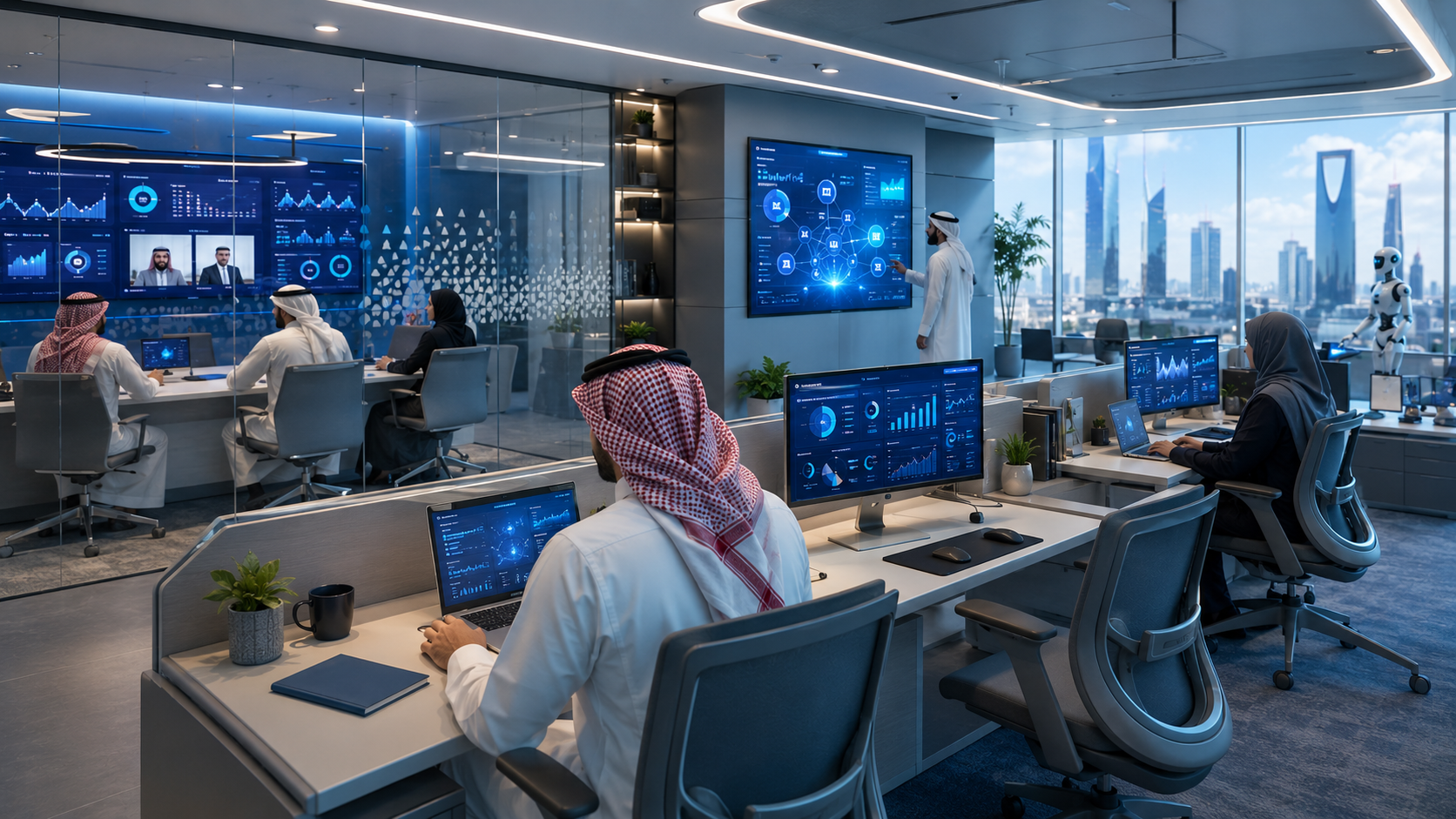
Smart Workplaces and Hybrid Work in Saudi Arabia
How AI Is Changing the Future of Work in Saudi Arabia
Work has changed dramatically in recent years. The traditional office is no longer the only model for managing teams, building productivity, or running daily operations. With the rise of digital tools, artificial intelligence, automation, and changing employee expectations, companies are moving toward more flexible and intelligent ways of working. This is where hybrid work and smart workplaces become important. Hybrid work is not only about allowing employees to work from home a few days a week. It is a new operating model that requires clear systems, digital collaboration, better communication, measurable outcomes, and smarter use of technology. A smart workplace is also not just a modern office with screens and fast internet. It is a work environment supported by tools, automation, data, and AI systems that help people work more efficiently, reduce manual tasks, and make better decisions. In Saudi Arabia, this transformation is becoming more relevant as businesses continue to adopt digital solutions, improve operational efficiency, and align with a more technology-driven economy. For many companies, smart workplaces are no longer a luxury. They are becoming a practical way to improve productivity, flexibility, and business performance. In this article, we explain what hybrid work means, what smart workplaces are, how AI supports modern work environments, and how Saudi businesses can start building a smarter and more productive workplace.What Is Hybrid Work?
Hybrid work is a work model that combines office-based work with remote work. An employee may work from the office on certain days and from home or another location on other days, depending on the company policy, team needs, and nature of the role. However, successful hybrid work is not just about giving employees permission to work outside the office. It requires a clear operating system. Companies need to define when physical presence is necessary, which tasks can be done remotely, how communication happens, where information is documented, and how performance is measured. Hybrid work can help businesses:- Reduce time wasted in commuting.
- Improve work-life balance.
- Increase employee satisfaction.
- Access talent from different cities.
- Reduce pressure on office space.
- Improve business continuity.
- Support more flexible team structures.
- Create a more outcome-focused work culture.
What Are Smart Workplaces?
A smart workplace is a work environment that uses technology to improve how people communicate, collaborate, manage tasks, use office space, access data, and complete daily work. A smart workplace does not mean adding technology for appearance only. It means using the right tools to make work easier, faster, clearer, and more measurable. A smart workplace may include:- Meeting room booking systems.
- Flexible desk reservation tools.
- Digital collaboration platforms.
- Smart meeting screens.
- Digital attendance systems.
- Automated meeting scheduling.
- Task and project management platforms.
- Customer service automation.
- Performance dashboards.
- Automated reporting systems.
- AI tools for writing, analysis, and organization.
- Knowledge management systems.
Why Hybrid Work Matters for Saudi Businesses
Saudi companies are operating in a fast-changing business environment. Competition is increasing, customer expectations are higher, and operational efficiency matters more than ever. This makes flexible work models and smart systems more important for companies that want to grow sustainably. Hybrid work gives businesses the ability to combine the benefits of office presence with the flexibility of remote work. For companies in Riyadh, Jeddah, Dammam, and other cities across Saudi Arabia, hybrid work can also expand hiring opportunities. Businesses may access skilled professionals without requiring everyone to be in one physical location all the time. It can also help small and medium businesses manage teams more efficiently, reduce some operational pressure, and create a better employee experience. However, hybrid work requires clear answers to important questions:- Which tasks require office presence?
- Which meetings can happen remotely?
- What are the official tools for communication?
- Where are decisions documented?
- How is performance measured?
- How do we maintain team culture?
- How do we protect files and data?
- How do we avoid unnecessary meetings?
The Role of AI in Smart Work Environments
Artificial intelligence is becoming a practical part of the modern workplace. It is no longer limited to large technology companies. Today, many businesses can use AI to reduce repetitive work, improve communication, analyze data, and support better decision-making. In a smart workplace, AI can help with:- Summarizing meetings.
- Prioritizing tasks.
- Drafting reports and documents.
- Analyzing performance data.
- Responding to repeated inquiries.
- Classifying customer requests.
- Preparing recurring reports.
- Supporting management decisions.
- Organizing internal knowledge.
- Automating follow-up messages.
AI automation helps businesses reduce repetitive work, analyze performance, and make faster operational decisions.
How Automation Improves Workplace Productivity
Automation means turning repeated tasks into automatic or semi-automatic workflows. The goal is not to replace employees. The goal is to reduce low-value repetitive work so employees can focus on tasks that require judgment, creativity, communication, and strategy. Tasks that can often be automated include:- Repeated data entry.
- Confirmation emails.
- Follow-up messages.
- Meeting scheduling.
- Performance reports.
- Lead classification.
- Routing requests to the right department.
- Customer support updates.
- Database updates.
- Alerts when an issue happens.
- Collecting data from multiple tools into one dashboard.
Digital Collaboration Tools for Hybrid Teams
Hybrid work cannot succeed without clear collaboration tools. If every team uses a different system, information becomes scattered and work becomes harder to track. A hybrid team usually needs:- A meeting platform.
- An internal chat tool.
- A project management system.
- Shared file storage.
- A knowledge base.
- A process documentation system.
- A performance dashboard.
- A customer request management system.
- Automation tools that connect platforms together.
Challenges of Hybrid Work and Smart Workplaces
Hybrid work and smart workplaces offer many benefits, but they also create challenges that need to be managed carefully. The first challenge is weak communication. When teams work from different locations, daily conversations may decrease, and shared understanding may become weaker. The second challenge is meeting overload. Some companies try to compensate for the lack of office presence by adding too many meetings, which reduces productivity instead of improving it. The third challenge is performance measurement. In hybrid work, attendance alone is not a strong measure of productivity. Companies need to focus more on outcomes, delivery, and quality of work. The fourth challenge is data security. Working outside the office requires clear policies for accessing files, systems, and sensitive information. The fifth challenge is resistance to change. Some employees or managers may prefer traditional work methods because they are used to them. The solution is not to force technology quickly. The better approach is to build a gradual plan that includes tools, policies, training, workflow design, and performance measurement.How Saudi Companies Can Start Building a Smart Workplace
Building a smart workplace does not start with buying more tools. It starts with understanding current work problems. Before choosing any system or platform, companies should ask:- Where does the team waste time?
- Which tasks are repeated every day?
- Which reports are prepared manually?
- Where does customer follow-up slow down?
- Which data is unclear to management?
- Which meetings can be reduced?
- Which processes are not documented?
- Which tools are currently used?
- Are the tools connected or separated?
A successful smart workplace starts with clear workflows, digital tools, automation opportunities, and measurable performance.
The Future of Smart Workplaces in Saudi Arabia
The future of work in Saudi Arabia is moving toward more flexibility, automation, and data-driven operations. As digital transformation continues, companies that use technology intelligently will be better positioned to compete. Smart workplaces will evolve from modern office spaces into connected business systems that help employees and managers make better decisions. We can expect more focus on:- Internal workflow automation.
- AI-supported customer service.
- Management dashboards.
- Performance analytics.
- Hybrid work systems.
- Internal knowledge management.
- Platform integrations.
- AI-assisted decision support.
- Digital employee experience.
- Smart reporting.
How WIDE Helps Businesses Automate Workflows
At WIDE, we do not treat AI as a temporary trend or a side experiment. We see AI automation as part of a business system that can reduce manual work, improve accuracy, and give management better visibility. We help businesses analyze current operations, identify repetitive tasks, and build practical automation solutions that fit their teams, tools, and goals. Our work may include:- Workflow analysis.
- Identifying automation opportunities.
- Automating repetitive tasks.
- Connecting digital tools.
- Improving performance reports.
- Automating customer follow-up.
- Supporting customer service with AI.
- Building clearer dashboards.
- Training teams on AI tools.
- Monitoring performance and improving systems.
FAQ
What is the difference between hybrid work and remote work?
Hybrid work combines office-based work with remote work, while remote work happens fully outside the office.What is a smart workplace?
A smart workplace is a work environment that uses technology, data, automation, and digital tools to improve productivity, collaboration, and workflow clarity.Is hybrid work suitable for every company?
Not in the same way. It is more suitable for companies where part of the work can be done digitally. It still requires clear policies, tools, and performance measurement.How does AI help in the workplace?
AI can help summarize meetings, analyze data, automate reports, organize tasks, support customer service, and improve decision-making speed.Does automation mean replacing employees?
No. The main goal of automation is to reduce repetitive work and help employees focus on higher-value tasks.How can a company start automating its work?
Start by analyzing daily repetitive tasks, identifying where time is wasted, then choosing automation solutions that fit the company’s workflow and team needs. Hybrid work and smart workplaces are no longer temporary trends. They are becoming part of the future of work in Saudi Arabia and around the world. Companies that want to improve productivity, employee experience, workflow clarity, and decision-making need to think about automation and AI as part of their operating strategy, not as optional tools. The shift does not start by buying many tools. It starts by understanding the current workflow. Where is time wasted? Where do errors repeat? Where do decisions slow down? Where can technology create a real difference? When a company combines hybrid work, digital collaboration, workflow automation, and AI, the workplace becomes more flexible and more productive. At WIDE, we help Saudi businesses build practical AI automation solutions that match their real needs and turn technology from an added cost into a tool for growth and operational efficiency. Contact WIDE today and start building a smarter, more productive workplace.Related AI Automation Articles
Explore more articles about artificial intelligence, automation, smart marketing systems, and digital transformation.
How AI Is Transforming Influencer Marketing in Saudi Arabia
AI Digital Influencers: The Future of Marketing?
AI Customer Service Automation and the Future of Smart Workplaces
How AI Marketing Automation Enhances Short-Form Content Performance
How AI Business Automation Helps Saudi Companies Reduce Costs and Increase Productivity
Smart Workplaces and Hybrid Work: How AI Is Changing the Future of Work in Saudi Arabia
Marketing Automation: How Businesses Use It to Generate Leads and Improve Performance
AI Trends in Saudi Arabia 2026: How Businesses Can Benefit
Discover the Top AI Trends in Saudi Arabia for 2026 and Learn How Your Business Can Stay Ahead of the Competition.
Human + AI Marketing Strategy: Why Businesses That Combine Artificial Intelligence with Human Expertise Achieve Better Marketing Results