
SEO Case Study: Sustainable Search Growth | WIDE
SEO Case Study: How WIDE Builds Sustainable Search Growth Without Spam Tactics
Not every rise in Google Search results is a sign of real SEO success. Some websites grow quickly because of short-term tactics: publishing large amounts of random content, building weak backlinks, targeting keywords that do not match the business, or chasing traffic that has no real commercial value. This kind of growth may look impressive for a short period, but it often becomes unstable when Google updates its systems and reassesses the quality, relevance, and trust signals behind a website. Sustainable SEO works differently. It is not built on tricks, shortcuts, or temporary ranking spikes. It is built on clarity. The clearer your website is to both users and search engines, the easier it becomes for Google to crawl, understand, index, and evaluate your pages. This case study explains how WIDE approaches SEO as a long-term growth system, not just a publishing activity. The focus is not only on increasing the number of indexed pages, but also on making sure those pages support business goals, match search intent, strengthen service pages, and attract the right audience. In WIDE’s current indexing data, 942 pages are indexed, while 664 pages are not indexed. These numbers do not mean that the work is complete. They show that the website is entering a broader indexing and discovery phase. This is an important step, but it is only the beginning. The next stage is to turn indexing into stronger visibility, better click-through rates, improved commercial keyword rankings, and more qualified leads. The real goal of SEO is not simply to make Google aware that a website exists. The goal is to help Google understand what the website offers, who it serves, how its articles connect to its service pages, and why its pages deserve to appear for the right search queries. That is the difference between temporary SEO and sustainable SEO.Why Appearing on Google Is Not Enough
Many businesses assume that SEO is only about getting their website to appear on Google. But visibility alone does not guarantee business results. A website may appear for irrelevant keywords. It may rank in positions that rarely get clicks. It may receive impressions from users who are not ready to buy, compare, or contact a service provider. In these cases, the problem is not always a lack of visibility. The problem is that the visibility is not commercially aligned. The more important question is: Is your website appearing in front of the right audience, at the right moment, with the right page? There is a major difference between a user searching for “what is SEO” and a user searching for “SEO company in Riyadh” or “SEO services for businesses.” The first user may only be looking for general information. The second user is closer to comparing providers, requesting a service, or making a business decision. That is why a commercial SEO strategy cannot rely only on informational keywords, even if those keywords generate high impressions. The right SEO visibility must support a clear business objective. If the company offers SEO services, the content should guide the reader toward the SEO service page. If the company offers business automation, the content should support the business automation service page. If the company offers social media management, the content should connect to the customer’s challenges around content planning, publishing, performance, and conversion. This is where search intent becomes essential. The purpose of content is not just to target a keyword because it has search volume. The real purpose is to understand why the user is searching, what stage they are in, what problem they want to solve, and which service page should support the next step. When content is built this way, an article becomes part of a commercial path. It is no longer just another page on the website. It becomes a bridge between the user’s question and the service that can solve the problem.What Google Search Console Indexing Data Shows
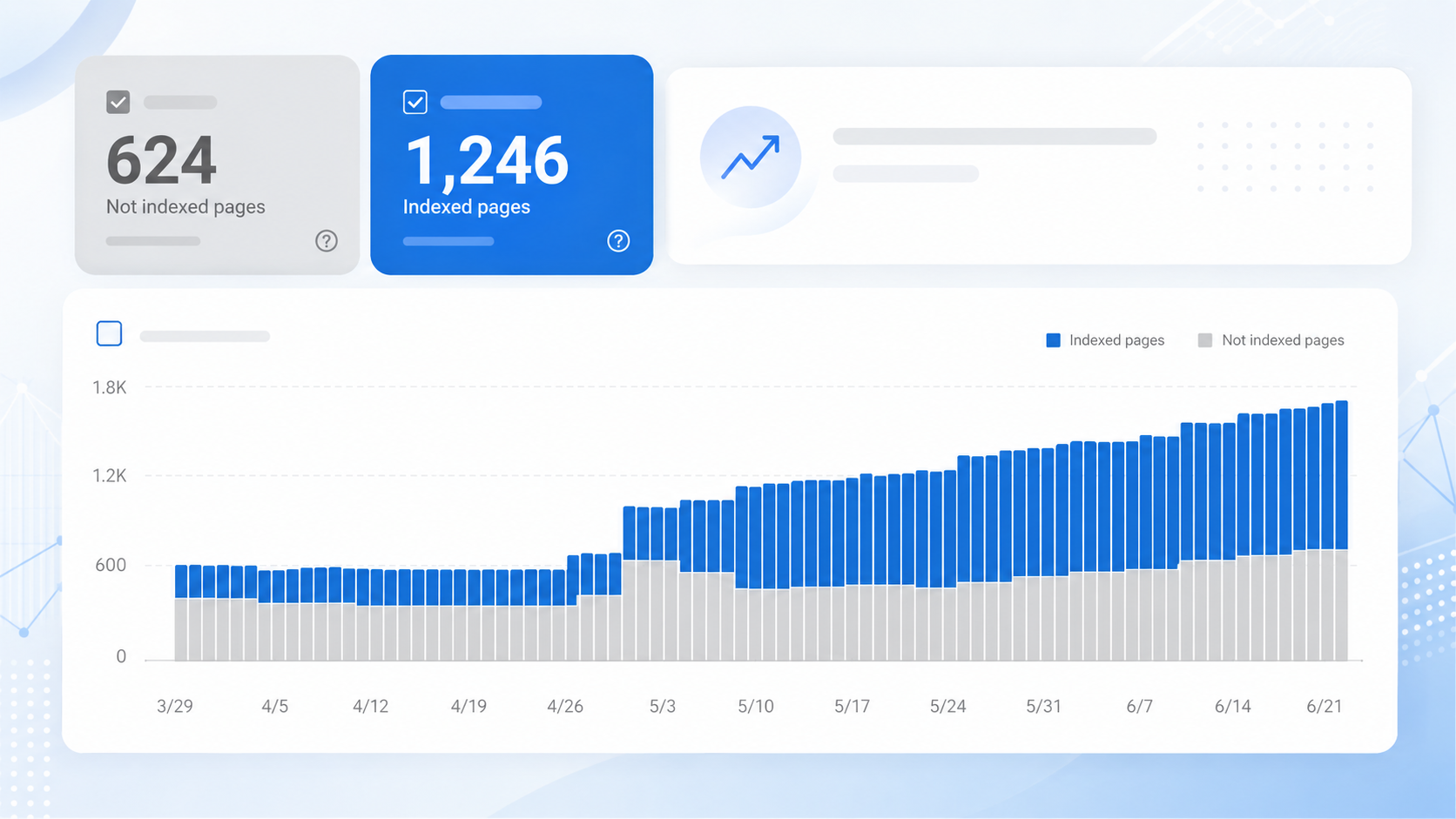
Google Search Console is one of the most important tools for understanding how Google interacts with a website. For WIDE, the indexing data shows that 942 pages are indexed, while 664 pages are not indexed. The chart also shows a gradual increase in indexed pages over time. This is a positive signal, but it must be understood correctly. An increase in indexed pages does not automatically mean that the website is ranking at the top of Google. It does not automatically mean that traffic or leads will increase immediately. What it does mean is that Google is discovering more pages, adding more of them to its index, and becoming able to evaluate them for relevant searches. Indexing is the beginning of the SEO journey, not the end. A page that is not indexed has no real chance of appearing in Google Search results. A page that is indexed enters the evaluation stage. After indexing, the more important questions begin: Does the page target the right keyword? Is the title compelling enough to earn clicks? Does the meta description create interest? Does the content match search intent? Does the page support a commercial service? Does the page have internal links that help Google and users understand its role? This is why indexing growth should be treated as an opportunity, not a final result. When more pages enter Google’s index, the next step is to improve their quality, relevance, click-through rate, and connection to business goals. At WIDE, indexing is not viewed as an isolated number. It is part of a wider SEO strategy. If the number of indexed pages increases without improving page quality, the impact may remain limited. But if indexing growth happens within a strong content structure, smart internal linking, and optimized service pages, it can become the foundation for real organic growth.The Difference Between Correct SEO and Temporary SEO
The difference between correct SEO and temporary SEO does not always appear in the first month. In some cases, weak strategies look successful at the beginning. Traffic may rise quickly. Some keywords may temporarily move up. Impressions may increase. But the real question is not whether the website moved. The real question is whether that movement is stable, targeted, and commercially valuable. Temporary SEO often depends on tactics that look attractive because they promise fast results. These may include publishing content without a strategy, repeating keywords unnaturally, building low-quality backlinks, creating many pages with little value, or attracting traffic that has no connection to the business. These tactics may create short-term movement, but they increase the risk of future drops. This is especially true when Google updates its systems and reassesses content quality, relevance, authority, and user value. Correct SEO starts from the foundation. What service are we trying to support? What commercial keywords matter? What is the user’s intent? Which articles should support the user before they make a decision? Which internal links should connect articles to service pages? Which pages need better titles, descriptions, and structure before producing more content? In a strong SEO strategy, an article is not an isolated asset. It is part of a system. It explains, supports, builds trust, and guides the reader toward the next step. The service page receives that interest and turns it into a potential lead. Google, in turn, sees that the website is not publishing random content. It is building topical coverage around specific business services. This kind of growth may be slower than shortcut-based SEO, but it is safer and more sustainable. The website does not rely on suspicious signals or irrelevant traffic. Instead, it builds clarity around its expertise. Over time, this helps Google better understand the relationship between the website’s pages and expand visibility to a more relevant audience.
Indexing growth is an important SEO signal, but it needs stronger CTR, commercial keyword rankings, and service page optimization to create business results.
How Proper SEO Helps Google Understand Your Website More Clearly
One of the strongest benefits of correct SEO is that it makes the website easier to understand. When a website is poorly organized, Google may still crawl its pages, but it may not clearly understand which pages are most important, which services the business offers, how the articles connect to those services, and who the target audience is. This can lead to scattered visibility, weak keyword relevance, and impressions that do not turn into clicks or leads. When SEO is done properly, the picture becomes clearer. Service pages become the main commercial pages. Articles support those service pages instead of standing alone. Internal links guide Google and users toward the right path. Titles, meta descriptions, headings, and content explain the intent of each page. This approach does not try to chase Google. It helps Google understand the website. That is a major difference. A good website does not need to trick the algorithm. It needs a clear structure, useful content, and pages that answer real search intent. When Google sees that clarity, crawling becomes easier, indexing becomes more meaningful, and the website’s topic becomes easier to evaluate. A useful way to think about this is to imagine a large library. If all the books are scattered without categories, it becomes difficult to understand what the library is about or which sections matter most. But if the books are organized by topic, each section has a clear label, and related books are placed together, the entire library becomes easier to navigate and understand. A website works the same way. Every page should have a purpose. Every article should support a topic. Every internal link should help build meaning. For WIDE, the goal of SEO is not only to increase the number of pages. The goal is to help Google understand that the website is connected to digital marketing, SEO, paid advertising, business automation, content, social media, and website development. When Google understands these relationships more clearly, the website has a better chance of appearing for users who are actually looking for these services. This is where sustainable SEO creates value. Google does not only see separate pages. It begins to see relationships. An article about search intent supports SEO services. An article about robots.txt supports technical SEO. An article about marketing automation supports AI automation and business automation. Over time, these connections help build topical trust. The result is not just more traffic. The result is better visibility quality. The goal is not for anyone to reach the website. The goal is for the right person to reach it: a business owner, marketing manager, e-commerce brand, or organization looking for a service provider that can improve visibility and turn the website into a lead generation channel.
Good SEO does not trick algorithms. It makes the website clearer, more useful, and easier for search engines and customers to understand.
Why Search Intent Is the Foundation of Sustainable SEO
Search intent is the real reason behind every search query. Users do not type keywords into Google randomly. They are trying to learn, compare, solve a problem, find a price, choose a provider, or make a decision. If a page does not match that intent, it may fail even if it contains a lot of information. In commercial SEO, search intent is often more important than search volume. A broad keyword with high search volume may bring visitors who never convert. A more specific commercial keyword with lower search volume may bring a user who is ready to contact a provider. This is why SEO success should not be measured only by article length, number of keywords, or total impressions. It should be measured by how well the content matches the user’s stage in the buying journey. For example, an article titled “What is SEO?” may be helpful for education, but it may not be the strongest article for attracting a ready-to-buy customer. On the other hand, an article like “How to Choose an SEO Company in Riyadh” or “Why Your Website Does Not Rank on Google” is closer to commercial intent because the reader likely has a problem and may be considering external support. This does not mean informational content should be removed. It means informational content should be guided. An informational article should still belong to a path. It should explain the problem, clarify the impact, and connect the reader to the right service when appropriate. Commercial articles should be more direct in showing the problem, presenting the solution, demonstrating expertise, and encouraging the reader to take the next step. At WIDE, this approach is central to content updates. The goal is no longer to publish general content only. The goal is to build content around commercial keywords, support service pages, and increase the chance of attracting qualified leads. Every article should answer clear questions: Who is the reader? What problem do they have? Which service can help them? What should they do after reading the article? When search intent is applied correctly, both content quality and Google’s understanding improve. The page becomes clearer. It serves a specific user, solves a specific problem, connects to a specific service, and supports a specific business outcome.Why Google Updates Affect Websites That Depend on Weak Tactics
Google updates are not random changes. Their purpose is to improve the quality of results shown to users. With major updates, Google may reassess many signals, including content quality, page usefulness, user experience, backlinks, search intent alignment, and overall site trust. Websites that depend on weak tactics may gain temporary movement, but they are usually more exposed to volatility and ranking drops. This does not always mean that the website was “penalized.” In many cases, Google simply reevaluates the results and decides that other pages are more useful, clearer, or better aligned with search intent. One of the common mistakes in SEO is focusing only on increasing traffic without understanding the quality of that traffic. A website may receive more visits from broad or irrelevant keywords, but that does not mean the business is improving. In some cases, irrelevant traffic may produce weak engagement, low service page visits, and no real lead generation. Low-quality backlinks, duplicated content, and large numbers of thin pages can also create unwanted signals around a website. These signals may not cause immediate damage, but over time they can reduce trust, especially if the content does not provide clear value or support a meaningful topic. A sustainable strategy reduces this risk because it does not depend on artificial growth. It builds the website as a clear entity: defined services, supporting articles, organized internal links, accurate titles, and pages that answer real user needs. When Google updates occur, a website built on clarity and value is better positioned because it does not rely on shortcuts. It relies on content quality, structure, relevance, and usefulness. This is why long-term SEO matters. Correct SEO may not create a huge jump in one week, but it builds a stronger foundation over time. Every optimized page, every service-focused article, every relevant internal link, and every improved title or description adds another signal that helps Google understand the website more confidently. For WIDE, the indexing growth is a positive indicator, but it is not the final goal. The goal is to turn indexing into visibility for commercial keywords, then turn visibility into clicks, and then turn those clicks into qualified leads. That is why the next stage after indexing is critical: improving service pages, strengthening titles and descriptions, reviewing internal links, and identifying the keywords where the website already has impressions but needs better performance.Why We Do Not Chase Random Traffic
Random traffic can look attractive in reports, but it does not create real business growth. If a website receives traffic from users who do not need the service, from countries the business does not target, or from keywords that have no connection to a purchase decision, those visits may increase numbers but not revenue. For business SEO, traffic quality matters more than traffic volume alone. One visit from a business owner searching for “SEO company in Riyadh” may be more valuable than hundreds of visits from users reading general definitions. A strong SEO strategy should not only ask, “How do we get more visitors?” It should also ask, “How do we attract the visitors most likely to contact us?” This does not mean every piece of content should be aggressively sales-driven. It means every piece of content should support a clear path. Some articles build awareness. Some explain the problem. Some compare solutions. Some help users move closer to a decision. But in the end, the content should connect to the company’s services and commercial pages. When this path is ignored, a website can become a random library of articles. It may contain a lot of content, but it does not guide the reader toward a decision. When content is built around search intent, each article becomes a potential entry point for a customer at a specific stage of their journey. This is why WIDE does not measure SEO success only by the number of articles, indexed pages, or impressions. These metrics matter, but they must be connected to business indicators: commercial keyword visibility, click-through rate, service page traffic, ranking improvement, and conversion opportunities.What WIDE Learned From This SEO Case Study
WIDE’s current SEO progress confirms that search engine optimization is not one task. It is a connected series of decisions. Publishing articles is not enough. Indexing pages is not enough. Adding keywords to content is not enough. True SEO progress happens when these elements become one system that supports a clear business goal.Indexing Is Important, but It Is Only the Beginning
The fact that 942 pages are indexed means that Google can see a larger part of the website. But this does not mean that every indexed page will automatically deliver results. Some pages may need better titles. Some may need stronger descriptions. Some may need internal links. Some may need to be rewritten to better match search intent. Indexing creates the opportunity. Optimization turns that opportunity into performance.Service Pages Must Be the Center of Commercial SEO
For any business website, service pages should be the center of the SEO strategy. Articles are important because they educate, explain, and build topical authority. But in the end, they should support the pages where users can take action. If the SEO service page is weak, dozens of articles will not fully compensate for it. If a business automation page is close to strong visibility but receives no clicks, the issue may be the title, description, or page positioning, not indexing alone. Service pages need to be clear, commercial, and helpful. They should explain the problem, the service, the process, the outcomes, and the reasons why the user should contact the company.Search Intent Changes the Way Content Is Written
An article written only to gain impressions is different from an article written to attract a potential customer. The first may focus on definitions and general explanations. The second starts from the user’s problem, explains the impact, presents the solution, and connects the reader to a relevant service. That is why WIDE’s content strategy has become more commercially focused. Every article should support a service page, target a meaningful intent, and help the reader move closer to a decision.Internal Linking Builds Meaning
Internal linking is not just about adding links inside content. It helps build a map of meaning for search engines and users. When an article about search intent links to the SEO service page, it tells Google that the article supports the SEO topic. When an article about robots.txt also supports the same service, it strengthens the technical SEO side of the topic. When related articles link to each other logically, Google begins to understand that the website covers the subject from multiple angles. Good internal linking helps users navigate and helps Google understand priorities.Sustainable Growth Requires Patience
SEO is not like a paid campaign that starts and stops according to the daily budget. SEO is a digital asset that compounds over time. Each correct improvement may not show immediate results, but it adds another layer of clarity and trust. Over time, this can lead to better indexing, wider visibility, closer ranking positions, higher-quality clicks, and stronger lead opportunities.The Practical Difference Between Sustainable Growth and Temporary Spikes
Temporary SEO growth is like building an attractive surface on top of a weak foundation. The website may look like it is improving at first, but when pressure appears, problems begin to show. Rankings may drop, traffic may decline, clicks may decrease, or the type of audience reaching the website may change. Sustainable growth starts from the foundation. The services are identified first. The commercial keywords are mapped. The service pages are improved. The supporting articles are planned. The internal links are structured. The performance is monitored through Google Search Console. The difference between the two approaches is clear in the way decisions are made. Temporary SEO asks: How can we get more traffic quickly? Sustainable SEO asks: How can we gain better visibility in front of the audience most likely to contact us? That difference matters. A website chasing traffic may publish about any topic with search volume. A website building commercial SEO chooses topics based on their connection to services, customer problems, and business outcomes. Temporary growth often ignores what happens after the visit. Sustainable SEO cares about the entire user path: Did the user find a useful answer? Did they understand the service? Did they visit a relevant service page? Did they find a clear way to contact the business? Did the page move them closer to a decision? This is why correct SEO is not only about rankings. It is about a complete journey that starts with a search result and ends with a qualified potential customer.How to Turn Indexing Into Clicks and Leads
Once pages enter Google’s index, the next stage is turning indexing into results. This stage requires more than publishing. It requires careful analysis and ongoing optimization. The first step is improving titles. A title in Google Search is not only a page name. It is the first offer a user sees. If the title is weak, generic, or unclear, users may ignore the result even if the page appears in a good position. A strong title should be clear, commercial, and connected to a problem, result, or service. The second step is improving the meta description. A meta description may not always directly improve ranking, but it can influence the decision to click. A good description explains what the user will find and gives them a reason to visit the page. For commercial content, it should connect the problem to the solution, not simply summarize the page. The third step is strengthening service pages. If articles attract interest, service pages convert that interest into action. A strong service page should include the problem, service details, process, outcomes, frequently asked questions, supporting articles, and a clear path to contact the company. The fourth step is improving internal linking. Important articles should not remain isolated. Each article should connect to the right service page, related articles in the same topic cluster, and contact paths when appropriate. This helps users navigate and helps Google understand which pages matter most. The fifth step is reviewing non-indexed pages. Not every non-indexed page is a problem, but the reason should be understood. Is the page thin? Is it duplicated? Is it blocked? Does it have no internal links? Does it lack value? This analysis helps clean the website instead of simply adding more pages without purpose. This is how indexing becomes a business opportunity. An indexed page becomes an asset that can be improved. A keyword with impressions but no clicks becomes an opportunity to improve titles and descriptions. An article with traffic becomes a channel that can support a service page.Does Your Website Need Healthier SEO?
If your website appears on Google but does not generate leads, the issue may not be visibility alone. The problem may be the type of keywords you appear for, weak service pages, unclear internal links, poor content intent, or too many pages that do not support a business objective. If your website had previous growth and then dropped, the solution is not always to publish more content. Sometimes the right solution is to review what has already been built. Do the articles support services? Are the backlinks natural? Is the content written for users or only for search engines? Are the most important pages clear? Are there commercial keywords close to stronger positions that need optimization? At WIDE, the process starts with diagnosis before execution. We review Google Search Console data, analyze keywords, evaluate indexed and non-indexed pages, identify priority service pages, and build a plan that combines service page optimization, supporting content, and technical cleanup. The goal is not only to produce attractive numbers. The goal is to build a path that helps the website appear in front of the right audience. Successful SEO is not measured only by traffic. It is measured by the business opportunities the website can create over time. If your website needs better visibility, or if your traffic is not turning into qualified leads, the first step is to review the current SEO strategy: Does it serve search intent? Does it support service pages? Does it attract the right audience? Is it building sustainable growth or relying on temporary movement?Good SEO Helps Google Understand Your Website Before Expanding Its Visibility
Search engine optimization is not a race to publish the highest number of articles. It is not about placing as many keywords as possible inside a page. Correct SEO is a process of building understanding. Every page should have a role. Every article should support a goal. Every internal link should guide users and search engines. Every service page should be ready to convert interest into action. WIDE’s indexing data is a positive indicator that the website’s crawlability and indexability are improving. But the real value begins when this progress turns into stronger visibility for commercial keywords, higher-quality clicks, stronger service pages, and better lead opportunities. The correct approach does not promise instant growth. It builds a stronger foundation. Over time, that foundation helps Google understand the website more confidently, connect its content to its services, and expand its visibility to the audience most likely to need what it offers. That is the core of sustainable SEO: the website should not simply be a collection of pages. It should be a clear system of services, content, internal links, and commercial messages working together to attract the right customers.FAQ
Does having more indexed pages mean SEO success?
No. Having more indexed pages is an important step because it means Google is discovering more of the website. But indexing alone does not guarantee business results. Real success appears when indexed pages start gaining visibility for relevant keywords, earning qualified clicks, and supporting service pages or lead generation paths.What is the difference between sustainable SEO and fast SEO?
Sustainable SEO is built on search intent, service page optimization, useful content, and internal linking. Fast SEO often relies on temporary tactics such as weak backlinks, duplicated content, or broad keywords that do not support the business. Sustainable SEO builds trust and clarity over time, while fast SEO may create temporary movement followed by decline.How does search intent improve SEO visibility?
Search intent helps content match what users actually want. When a website understands whether the user is looking for information, comparison, a service, a price, or a solution, it can create a page that better satisfies that need. This improves visibility quality and attracts more relevant visitors.Do Google updates affect SEO performance?
Yes. Google updates can affect rankings because they reassess content quality, user experience, search intent alignment, and website trust. Websites that rely on weak tactics are more exposed to volatility, while websites that build clear, useful, and organized content are usually better positioned for long-term stability.When do SEO results start to appear?
It depends on the website’s condition, competition, content quality, technical issues, and service page strength. Some improvements, such as better titles and descriptions, may show impact faster. Building topical trust and improving commercial keyword rankings usually takes more time. The most important factor is that the work follows a clear strategy rather than random publishing.Related SEO Articles
Discover more articles about SEO strategies, search visibility, user behavior, and practical ways to attract more qualified customers through your website.
Why Doesn’t Your Website Appear in Google Search Results?
What Is Search Engine Optimization (SEO)?
How to Understand Search Intent and Attract More Customers
Why Do Websites Fail to Convert Visitors into Customers?
Entity-Based SEO: The Complete Guide for Saudi Businesses
The Plateau of Latent Potential: Why Digital Marketing Results Take Time
How to Choose an SEO Company in Saudi Arabia: A Practical Guide
The Larger Market Formula: Why Not Everyone Is Ready to Buy
SEO Pricing in Saudi Arabia: Costs, Packages and What to Expect
Backlinks in SEO: How to Build External Links That Improve Website Trust
Search Intent: How to Understand What Users Want and Get More Leads
Robots.txt File: How to Use It for Better Technical SEO
SEO Case Study: How WIDE Builds Sustainable Search Growth