

How to Prepare Your Business Website for Google AI Mode and AI Overviews
Google Search is no longer limited to a list of traditional blue links. Users can now ask longer questions, compare multiple options, explore complex topics, and receive AI-generated summaries supported by relevant websites and sources. Features such as Google AI Mode and AI Overviews are changing how people discover information, evaluate businesses, and make purchasing decisions. For companies, this change does not make search engine optimization less important. It makes a strong SEO foundation even more valuable. Google still needs to discover, crawl, index, understand, and evaluate web pages before they can become eligible to appear in traditional search results or AI-powered search experiences. A company with technically accessible pages, useful service content, strong internal linking, clear expertise, and a reliable brand presence is more likely to benefit than a business relying on generic articles and weak service pages. The real question is not whether SEO is disappearing. The more useful question is: Is your website prepared for the way customers now search? This guide explains how Google AI Mode and AI Overviews affect business visibility, what still matters in SEO, why some websites may struggle to appear, and how Saudi businesses can build a search strategy that supports visibility, traffic, inquiries, and qualified leads.What Is Google AI Mode?
Google AI Mode is an AI-powered search experience designed to help users explore questions that require more context, comparison, or reasoning than a simple search query. In traditional search, a business owner may perform several separate searches: Best SEO company in Saudi Arabia. SEO service cost in Riyadh. How long does SEO take? Should I invest in SEO or Google Ads? How do I evaluate an SEO agency? With AI-powered search, the same person may ask one detailed question: What is the best way to improve visibility for a service business in Riyadh if the website is outdated, competition is high, the budget is limited, and the company needs more qualified leads? This type of query combines several considerations: Budget. Competition. Website quality. Location. Timeframe. Marketing objectives. Customer acquisition. AI Mode attempts to understand the full context, organize the available information, and provide an answer supported by links and sources that may help the user continue their research.How Is AI Mode Different From Traditional Search?
Traditional search generally presents a ranked list of pages and allows the user to decide which result to visit. AI Mode can organize information into a more connected response. It may help the user compare options, understand trade-offs, explore related questions, and continue the conversation through follow-up queries. Websites remain an important part of this experience. The difference is that businesses are no longer competing only for one short keyword and one traditional ranking position. A page may also have an opportunity to appear as: A supporting source. A recommended service resource. A cited page within a comparison. A helpful explanation for one part of a complex question. A business option relevant to the user’s location or need. This makes content depth and context more important. A page that explains only one narrow definition may be less useful than a page that connects the customer’s problem, available solutions, expected outcomes, risks, and next steps.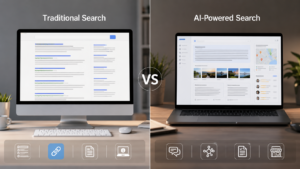
Traditional search presents individual links, while AI-powered search connects information, sources, comparisons, and conversational questions.
What Types of Searches Work Well With AI Mode?
AI Mode is particularly useful when users want to: Compare several services. Understand a complicated topic. Evaluate different providers. Explore a problem before choosing a solution. Ask multiple related questions. Balance price, quality, time, and risk. Receive recommendations based on specific conditions. This matters for service businesses because potential customers do not always begin by searching for the exact service name. They may search for the problem instead. A business owner may not initially search for “SEO services.” They may ask: Why is my website not generating leads? Why are my indexed pages increasing without more inquiries? Should I improve my website or increase my advertising budget? How can I compete with larger companies on Google? How do I know whether my SEO agency is doing real work? Content that answers these questions can support the customer journey before the user is ready to contact a provider.What Are AI Overviews?
AI Overviews are AI-generated summaries that may appear within Google Search results for certain queries. Their purpose is to help users understand a topic quickly while providing links that allow them to explore the information in greater depth. AI Overviews do not appear for every search. Their visibility may vary depending on the query, location, user, and Google’s assessment of whether an AI-generated summary adds value.What Is the Difference Between AI Overviews and AI Mode?
AI Overviews usually appear within the normal search results as a summary for a particular query. AI Mode provides a broader search experience that allows the user to explore the topic, ask follow-up questions, and evaluate more complex options. From a website owner’s perspective, the foundations are similar. A page should be: Accessible to Google. Eligible for indexing. Relevant to the user’s question. Clear and useful. Supported by reliable information. Connected to the broader structure of the website. There is no separate button that guarantees inclusion in either experience.Can a Business Website Appear as a Source?
Yes. Service pages, business websites, articles, product pages, local listings, and other relevant content can appear as supporting sources or links. However, appearance is not guaranteed. Google may consider factors such as: Relevance to the query. Content quality. Technical accessibility. Original value. Clarity. Expertise. Website structure. User experience. Brand credibility. Location and business information. A WordPress plugin or a special file cannot force Google to choose a page. The website must earn visibility by being genuinely useful and technically eligible.Is SEO Still Important in AI-Powered Search?
Yes. Google’s AI-powered search features continue to rely on core Search systems. This means the principles that help Google discover, understand, and evaluate a website remain important. A page cannot benefit from an AI-focused content strategy if Google cannot crawl or index it properly. Similarly, adding popular AI-related terms to weak content will not solve problems such as: Incorrect canonical tags. Blocked pages. Broken internal links. Duplicate URLs. Slow mobile performance. Weak service pages. Thin content. Poor website structure. SEO remains the foundation that supports visibility across traditional and AI-powered search experiences.Why Does Indexing Still Matter?
For a page to be considered for search visibility, Google generally needs to discover and index it. This requires checking questions such as: Can Google crawl the URL? Is the page blocked by robots.txt? Does the page contain a noindex directive? Does it return a successful status code? Is the canonical URL correct? Is the page linked from other parts of the website? Does the sitemap include the correct version? Does the Arabic page point to the correct English alternative? Is the content visible and usable on mobile devices? Are duplicate versions competing with one another? Before developing a strategy for AI Mode, a company should confirm that its most important service and content pages are technically accessible.Are AEO and GEO Replacements for SEO?
AEO is commonly used to describe answer engine optimization. GEO is commonly used to describe generative engine optimization. These terms can help describe specific areas of search visibility, but they do not replace SEO. In practical terms, businesses still need: A technically stable website. Crawlable and indexable pages. Useful service content. Original insights. Strong internal linking. Topic authority. Trust signals. A good user experience. Conversion tracking. Clear contact paths. These are central SEO principles. The main evolution is that content now needs to address more complex questions and support a longer decision-making journey.How Is AI Changing Search Behavior?
Older SEO strategies often focused heavily on one keyword and one page. Keywords remain useful, but search systems are better at interpreting meaning, context, entities, and relationships between topics. A potential client may search for: How to generate more leads from a company website. Why an agency website receives traffic but no inquiries. Whether SEO is suitable for a small business. How to choose between SEO and paid advertising. How to evaluate a digital marketing proposal. Why competitors appear in search while another company does not. These questions may all connect to SEO services even when the user does not use the phrase “SEO agency.” For this reason, a business website should not only repeat service names. It should cover the problems, decisions, comparisons, objections, and outcomes associated with those services.What Makes Business Content Eligible for Better AI Search Visibility?
There is no guaranteed formula, but certain qualities make content more useful to both users and search systems.Create Original Content Instead of Rewriting Competitors
If a company reviews the first ten search results and simply rewrites the same information, it is not providing a strong reason for users or Google to prefer its page. Stronger content may include: First-hand experience. Original data. A case study. A practical comparison. A detailed process. Lessons learned from a real project. Common mistakes identified during client work. A professional opinion supported by evidence. Results before and after an improvement. Answers that competitors avoid discussing. WIDE, for example, can use its own Search Console growth, indexing improvements, website updates, and internal linking experience to create content based on real work rather than generic summaries.Address a Real Commercial Need
A business article should help the reader make a decision, not only understand a definition. Instead of publishing another general article about the importance of SEO, a stronger topic may address: How to know whether your company needs SEO. Why more indexed pages do not always generate more customers. When to choose SEO and when to choose Google Ads. How to compare SEO proposals. What should happen during the first three months of an SEO project. Why impressions increase while clicks remain low. Which service pages should be optimized first. These topics attract readers with genuine business problems and stronger commercial intent.Build Strong Service Pages
A service page should not consist of a short paragraph followed by a contact button. A useful service page should explain: What the service is. Which problem it solves. Who it is suitable for. How the process works. What the client can realistically expect. What affects the timeline. How performance is measured. What is included and excluded. Why the company is qualified. What the next step should be. Strong articles may attract visitors, but strong service pages convert that attention into inquiries.Demonstrate Experience and Trust
A company should not only claim expertise. The website should demonstrate it. Trust can be supported through: Case studies. Clear methodologies. Original examples. Named services. Accurate company information. Realistic expectations. Updated content. Professional author or company information. Reliable sources. Consistent contact details. Clear policies. A strong About page. The more consistent and transparent the website is, the easier it becomes for potential clients to evaluate the business.Why Might Your Website Not Appear in Google AI Mode?
A website may contain many articles and still receive limited visibility. The reason is usually not a missing AI trick. It is often a combination of technical, content, authority, and user-experience issues.The Page Is Not Properly Indexed
A page cannot compete effectively if it is not in Google’s index. Common causes include: A noindex directive. Incorrect robots.txt rules. A wrong canonical URL. Broken redirects. Server errors. Duplicate content. Weak internal linking. Orphan pages. Incorrect sitemap entries. Conflicting Arabic and English URLs. Search Console should be used to inspect important URLs individually rather than assuming every published page is indexed correctly.The Content Is Too Generic
An article such as “Ten Benefits of Digital Marketing” may be accurate, but it is easy to replace and highly competitive. Generic content often fails to answer a specific commercial question. More useful content could include: A Saudi website performance analysis. A real indexing case study. A comparison between two marketing approaches. An explanation of a decision made during a project. A breakdown of technical problems and how they were fixed. A realistic assessment of what did and did not improve. The more difficult the content is to replace with a generic summary, the more valuable it becomes.Internal Linking Is Weak
Internal links help users and Google understand how pages relate to one another. A strong customer journey may include: An article explaining the problem. An article comparing possible solutions. An advanced guide. A case study. A service page. A contact page. Without this structure, even strong content may remain isolated and fail to support the commercial goal of the website.Service Pages Are Weaker Than Blog Articles
Many websites invest heavily in long articles while leaving service pages short and unconvincing. The result may be informational traffic without meaningful inquiries. If the objective is lead generation, articles should support the service pages, and the service pages must be prepared to convert visitors.Brand Signals Are Inconsistent
Potential clients may evaluate the website, Google Business Profile, social media accounts, business directories, and online reviews before making contact. Inconsistency can reduce trust. Businesses should maintain consistent: Brand name. Phone number. Email address. Business description. Service information. Location details. Social profiles. Visual identity. Website URLs. A clear and consistent brand presence helps both users and search systems understand the business.User Experience Is Weak
Visibility alone does not generate leads. A visitor may leave because of: Slow loading. Poor mobile design. Confusing navigation. Broken links. Small text. Weak calls to action. Unclear service information. A long or malfunctioning form. Too many pop-ups. An outdated design. The objective is not only to appear. The visitor should understand the service, trust the provider, and know how to take the next step.How to Prepare Your Website for AI-Powered Search
The right strategy is not to create a separate page labelled “AI SEO” while ignoring the rest of the website. The entire search and conversion system should be strengthened.Begin With Technical SEO
Review: Indexing. Crawlability. Robots.txt. XML sitemaps. Canonical tags. Redirects. 404 errors. Mobile usability. Page speed. Duplicate content. JavaScript rendering issues. Internal links. Arabic and English versions. Hreflang implementation. Heading structure. Image optimization. Search Console coverage. A technical issue may prevent Google from reaching the best content on the website.Improve Service Pages Before Publishing More Articles
Before creating additional content, assess whether the commercial pages are ready. Ask: Does the page clearly describe the service? Does it explain the customer’s problem? Does it address buying concerns? Does it show the process? Does it include realistic outcomes? Does it contain a clear call to action? Is contacting the company easy? Does it link to supporting articles? Publishing more content will not solve a weak conversion path.Build a Topic Cluster Around Every Service
Each WIDE service should be supported by a connected group of pages. For an SEO cluster, the content may cover: SEO fundamentals. Website visibility problems. Search intent. Technical SEO. Indexing. Internal linking. Entity-based SEO. CTR improvement. Service page optimization. SEO agency selection. Search Console case studies. AI-powered search. Performance measurement. Each article should serve a specific purpose and link logically to the main service page and related articles.Publish Original Case Studies
A case study is often more persuasive than a general explanation. It may include: The starting position. The main problems. The actions taken. The timeframe. The results. What did not improve yet. Lessons learned. The next stage. A company does not need to reveal sensitive client information. It can use anonymized data or its own website performance when presented honestly and without exaggerated conclusions.Strengthen Internal Linking
A commercial article should usually connect to: The main service page. A related problem-focused article. A more advanced guide. A case study. A contact page where appropriate. Anchor text should describe the destination clearly instead of using generic phrases such as “click here.”Use Images and Video When They Add Meaning
Visual content should explain something useful. Examples include: Traditional search versus AI-powered search. The relationship between crawling, indexing, and visibility. An internal linking structure. A Search Console performance trend. A lead-generation journey. A service delivery process. Images should also use appropriate file names, alternative text, compression, and dimensions so they do not damage page performance.Maintain Accurate Google Business Profile Information
For businesses serving customers in Saudi Arabia, local business information should remain accurate. Review: Business name. Primary category. Services. Description. Phone number. Website. Location. Working hours. Images. Reviews. Responses to reviews. Consistent local information can help users and Google understand the company’s relevance to location-based searches.
A sustainable AI search strategy connects crawlability, indexing, helpful content, topical authority, brand trust, traffic, and qualified leads.
Do You Need an llms.txt File?
There has been significant discussion about creating anllms.txt file to help AI systems understand websites.
For Google Search visibility, this file is not required.
It does not provide a special ranking advantage in Google AI Mode or AI Overviews.
A company may maintain it for another service that uses it, but it should not be treated as a replacement for:
Technical SEO.
Indexing.
Original content.
Internal linking.
Strong service pages.
Website performance.
Brand authority.
There is no single file that can compensate for a weak website.
Do You Need Special Schema for AI Mode?
There is no special Schema markup that guarantees visibility in AI Mode or AI Overviews. Structured data remains useful when it accurately describes the page and supports eligibility for relevant rich results. Businesses should: Use the appropriate structured data type. Match the markup to visible content. Avoid misleading information. Test implementation. Keep information updated. Do not expect structured data alone to improve rankings. Schema supports a broader SEO strategy. It does not replace content quality or technical accessibility.Should Articles Be Divided Into Very Small Sections?
Content should be organized for users, not artificially fragmented for AI systems. A useful structure normally includes: A clear title. A direct introduction. Logical H2 and H3 headings. Focused paragraphs. Examples. Lists where helpful. Frequently asked questions. A practical conclusion. There is no universal ideal article length. Some subjects require a detailed guide. Others can be answered in a shorter page. The correct length is the length required to answer the user’s need without unnecessary repetition.Does AI-Generated Content Harm SEO?
Using generative AI for research, outlining, editing, or content support is not automatically a problem. The risk appears when businesses publish large volumes of weak pages without: Original experience. Human review. Fact-checking. Editorial quality. A clear purpose. Commercial relevance. Unique value. A page may be grammatically correct but still offer nothing beyond what already exists across hundreds of websites. AI should support expertise, not replace it.How to Measure AI Search Visibility
Measurement should not stop at impressions. A business should connect search visibility to website behavior and commercial outcomes.Monitor Google Search Console
Track: Impressions. Clicks. CTR. Average position. Queries. Pages. Countries. Devices. Changes over time. Google has also introduced dedicated performance reporting for generative AI search features for eligible properties. These reports can provide views related to impressions, pages, countries, devices, and dates. Availability may vary, so businesses should continue using the standard performance reports when a dedicated report is not visible.Connect Search Console With Google Analytics
Search Console shows what happens before the visit. Google Analytics helps explain what happens after the visitor enters the website. Review: Landing pages. Engaged sessions. Service page visits. Navigation paths. Contact button clicks. Form submissions. Phone actions. Email actions. Qualified inquiries. The objective is not only to attract traffic. The website should attract relevant visitors and move them toward a meaningful action.Watch Long-Tail and Conversational Queries
Longer searches can reveal: Customer problems. Buying concerns. Common objections. Comparison needs. Missing content. New article opportunities. Weak sections within service pages. These queries can be used to improve both content planning and conversion messaging.Monitor Branded Search
An increase in searches for the company name may indicate growing awareness. A user may first discover WIDE through an article or AI-powered result, then return later by searching for the brand directly. For this reason, the value of visibility should not always be judged only by the first click.Common Mistakes to Avoid
Publishing One Page for Every Minor Query
A company does not need hundreds of nearly identical pages targeting every possible phrase. This can lead to: Thin content. Keyword cannibalization. Duplicate intent. Poor site quality. A confusing structure. It is usually better to publish a comprehensive, well-organized page and improve it using real search data.Repeating Keywords Excessively
Repeating “Google AI Mode SEO” in every paragraph will not improve the article. Use related terms naturally and focus on answering the reader’s questions clearly.Buying Artificial Mentions and Weak Links
Do not build an AI search strategy around purchasing low-quality mentions, comments, profiles, or links. Sustainable authority is built through: Useful content. Real partnerships. Credible directories. Industry coverage. Client experience. Original research. Pages that genuinely deserve references.Ignoring Service Pages
Articles may increase traffic, but weak service pages can prevent that traffic from turning into business. Every content cluster should support a clear commercial destination.Expecting Immediate Results
SEO is not an instant switch. Crawling or indexing changes may appear quickly, but building rankings, authority, and consistent lead generation takes time. Businesses should monitor trends over weeks and months instead of judging performance based on one day.How WIDE Helps Businesses Adapt to AI-Powered Search
A successful search strategy combines technical SEO, content, brand authority, user experience, and conversion optimization. WIDE can support this process by: Reviewing crawlability and indexing. Identifying weak and duplicate pages. Improving service pages. Selecting commercially relevant topics. Building connected topic clusters. Strengthening internal links. Optimizing Arabic and English versions independently. Improving titles and meta descriptions. Reviewing mobile usability. Analyzing Search Console and Google Analytics. Connecting organic traffic to inquiries and qualified leads. The objective is not to chase every new marketing term. The objective is to build a website that Google can understand and customers can trust.FAQ
What is Google AI Mode?
Google AI Mode is an AI-powered search experience that helps users explore complex questions, compare options, and continue their research through follow-up queries and supporting sources.What is the difference between AI Mode and AI Overviews?
AI Overviews provide a summary within some traditional search results. AI Mode offers a broader experience designed for deeper exploration and conversational follow-up.Is SEO still important?
Yes. Technical accessibility, indexing, helpful content, internal linking, authority, and user experience remain important for both traditional and AI-powered Google Search experiences.Do I need a separate GEO strategy?
GEO can be used to describe optimization for generative search, but the practical foundation remains strong SEO, original content, clear service pages, and trustworthy business information.Does my website need an llms.txt file?
No. Anllms.txt file is not required for visibility in Google AI Mode or AI Overviews and does not provide a special Google ranking advantage.
Is there special Schema markup for AI search?
No special Schema guarantees inclusion in AI-powered search features. Continue using accurate structured data that matches the visible page content.Why does a competitor appear while my website does not?
The competitor may have stronger content, better technical accessibility, clearer service pages, more relevant experience, stronger internal links, or more consistent trust signals.Can visibility in AI Overviews be guaranteed?
No. Google decides which pages and sources are relevant for each query and context. Meeting best practices improves eligibility but does not guarantee selection.Are longer articles always better?
No. The best article is the one that satisfies the search need clearly and completely without unnecessary repetition.How can I measure whether the strategy is working?
Track indexing, impressions, clicks, CTR, ranking trends, service page visits, contact actions, inquiries, and qualified leads. Do not judge success only by the number of articles published. Google AI Mode and AI Overviews do not eliminate SEO. They increase the importance of building a website that is technically accessible, commercially relevant, useful, and trustworthy. Businesses that rely on generic articles and weak service pages may struggle even if they publish large amounts of content. Companies that improve technical SEO, demonstrate real expertise, build strong topic clusters, connect articles to service pages, and create a clear customer journey are building a more sustainable digital asset. The objective should not be to appear in one AI-generated answer. The objective should be to make the business a credible and useful source whenever potential customers search for the problem, compare solutions, or look for the right provider.Related SEO Articles
Discover more articles about SEO strategies, search visibility, user behavior, and practical ways to attract more qualified customers through your website.
Why Doesn’t Your Website Appear in Google Search Results?
What Is Search Engine Optimization (SEO)?
How to Understand Search Intent and Attract More Customers
Why Do Websites Fail to Convert Visitors into Customers?
Entity-Based SEO: The Complete Guide for Saudi Businesses
The Plateau of Latent Potential: Why Digital Marketing Results Take Time
How to Choose an SEO Company in Saudi Arabia: A Practical Guide
The Larger Market Formula: Why Not Everyone Is Ready to Buy
SEO Pricing in Saudi Arabia: Costs, Packages and What to Expect
Backlinks in SEO: How to Build External Links That Improve Website Trust
Search Intent: How to Understand What Users Want and Get More Leads
Robots.txt File: How to Use It for Better Technical SEO
How to Prepare Your Business Website for Google AI Mode and AI Overviews
SEO for Businesses: How to Increase Visibility and Generate Qualified Leads
Why Doesn’t Your Website Rank on Google? Common SEO Mistakes That Hurt Your Visibility
Best SEO Tools for Businesses: The Complete Guide to Choosing Professional SEO Software