

Entity-Based SEO: Why Google No Longer Relies on Keywords Alone
Search engine optimization has evolved dramatically over the past decade. Businesses once focused almost entirely on finding high-volume keywords and placing them throughout their websites in hopes of improving rankings. While keywords remain important, modern search engines have become far more sophisticated.
Today, Google aims to understand the meaning behind content rather than simply matching words on a page. It analyzes relationships between people, organizations, products, services, locations, and concepts to determine whether a webpage genuinely answers a user’s question.
This shift has introduced a more advanced approach known as Entity-Based SEO.
Instead of optimizing individual keywords in isolation, Entity-Based SEO helps search engines understand the entities within your content and how they relate to one another. This allows Google to evaluate topical expertise, context, and authority more accurately.
The importance of entity optimization has grown even further with AI-powered search experiences such as Google AI Overviews, ChatGPT, and Perplexity, where semantic understanding plays a much larger role than traditional keyword matching.
Businesses that continue relying solely on outdated keyword-focused SEO strategies risk losing visibility to competitors that organize their content around entities, topical relevance, and user intent.
In this guide, you’ll learn what Entity-Based SEO is, how it works, why it matters for modern search, and how businesses can use it to build sustainable organic growth.
What Is Entity-Based SEO?
An entity is anything that can be uniquely identified regardless of language or wording.
Examples include:
- Companies
- Products
- Services
- Brands
- People
- Organizations
- Cities
- Technologies
- Events
Unlike traditional keyword optimization, Entity-Based SEO focuses on helping search engines understand these entities and the relationships between them.
For example, when Google encounters a page discussing digital marketing, it doesn’t simply look for the phrase “digital marketing.”
Instead, it analyzes whether the page also references related entities such as:
- SEO
- Google Ads
- Content Marketing
- User Experience (UX)
- Conversion Rate Optimization (CRO)
- AI Automation
- Analytics
- Search Intent
These relationships provide stronger contextual signals than keyword repetition alone.
Why Google No Longer Depends Only on Keywords
Earlier generations of search engines relied heavily on exact keyword matching.
This allowed websites to rank simply by repeating the same keyword multiple times—even when the overall content offered little value.
Modern Google algorithms have changed that completely.
Updates such as:
- Hummingbird
- RankBrain
- BERT
- MUM
enable Google to understand language, context, and intent at a much deeper level.
Instead of asking:
“Does this page contain the keyword?”
Google increasingly asks:
“Does this page fully explain the topic?”
“Does it demonstrate expertise?”
“Does it connect related concepts?”
“Will users find this page genuinely helpful?”
Entity-Based SEO answers these questions by organizing information around meaningful concepts instead of isolated phrases.
How Google Understands Entities
One of Google’s most important technologies is the Knowledge Graph, which connects billions of entities and the relationships between them.
Rather than storing only words, Google maps connections between:
- Businesses
- Products
- Services
- Brands
- People
- Industries
- Locations
- Organizations
When Google crawls a webpage, it attempts to identify these entities and determine how they relate to information already stored within its Knowledge Graph.
For example, an article discussing SEO may naturally connect with entities such as:
- Structured Data
- Technical SEO
- Core Web Vitals
- Search Intent
- Google Search Console
- Topical Authority
- Website Architecture
The richer these relationships become, the easier it is for Google to understand the expertise and context behind the content.
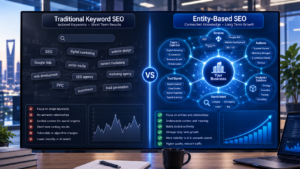
Modern search engines analyze relationships between entities instead of matching keywords alone.
The Relationship Between Entity-Based SEO and Topical Authority
Entity-Based SEO and Topical Authority are closely connected, but they are not the same concept.
Entity-Based SEO focuses on helping Google understand the entities within your content and the relationships between them.
Topical Authority, on the other hand, demonstrates that your website has comprehensive expertise in a specific subject by covering every important aspect of that topic.
For example, if your company provides SEO services, publishing a single article titled “What Is SEO?” is no longer enough.
A strong topical authority strategy would also include content covering:
- Technical SEO
- Keyword Research
- On-Page SEO
- Local SEO
- E-Commerce SEO
- Internal Linking
- Core Web Vitals
- Structured Data
- Search Intent
- AI SEO
- Google Search Console
- Entity-Based SEO
When these articles are properly interconnected through internal links, Google gains confidence that your website is a reliable source of expertise rather than a collection of unrelated blog posts.
This is why professional SEO strategies increasingly focus on building topic clusters instead of isolated articles.
How Entity-Based SEO Improves Search Rankings
Entity optimization helps search engines understand the context behind your content instead of relying on keyword repetition alone.
Some of its biggest advantages include:
Better Content Understanding
Entities help Google understand what your page is actually about.
Instead of analyzing individual words, Google’s algorithms evaluate the relationships between concepts, making it easier to classify your content correctly.
Improved Visibility in AI Search
AI-powered search experiences such as Google AI Overviews rely heavily on semantic understanding.
Content built around entities has a greater chance of being referenced because it provides comprehensive, well-connected information rather than isolated keyword-focused answers.
Stronger Topical Authority
As your website publishes more high-quality content covering related entities, Google gains stronger signals about your expertise.
Over time, this can improve your ability to rank for highly competitive search terms.
Smarter Internal Linking
Entity-Based SEO naturally encourages logical internal linking.
Articles discussing related concepts support one another, making it easier for users—and search engines—to navigate your website.
Better User Experience
Visitors rarely search for just one answer.
Someone reading about SEO may also want to learn about technical optimization, content strategy, structured data, or website performance.
Providing these connections keeps users engaged longer and increases the likelihood of conversions.
How to Build an Entity-Based SEO Strategy
Implementing Entity-Based SEO requires much more than adding Schema markup.
It starts with understanding your business, your customers, and the entities that define your industry.
Identify Your Primary Entity
First, determine the main entity you want Google to associate with your business.
Examples include:
- Digital Marketing Agency
- SEO Agency
- Web Design Company
- AI Automation Provider
- E-Commerce Development Company
Every piece of content should strengthen this primary entity.
Identify Related Entities
Next, build a list of entities closely connected to your primary topic.
For an SEO agency, these might include:
- Technical SEO
- Search Intent
- Google Search Console
- Core Web Vitals
- Structured Data
- Internal Linking
- Content Strategy
- Local SEO
- User Experience
- Website Architecture
These related entities become the foundation of your content strategy.
Build Topic Clusters
Rather than publishing disconnected articles, organize your content into topic clusters.
Each supporting article should strengthen the pillar topic while linking naturally to related resources.
This creates a knowledge network that both users and search engines can easily understand.
Use Structured Data
Structured Data helps search engines identify entities more accurately.
Depending on the page, you may implement:
- Organization Schema
- Service Schema
- Article Schema
- FAQ Schema
- Breadcrumb Schema
- Product Schema
While structured data alone won’t improve rankings, it helps Google interpret your content more efficiently.
Keep Content Updated
Entity relationships evolve over time.
Google continually expands its understanding of industries, technologies, and user behavior.
Refreshing important articles with new information helps maintain relevance and authority.

Google Knowledge Graph enables search engines to understand entities and their relationships.
Common Entity-Based SEO Mistakes
Many businesses understand that Google has evolved beyond simple keyword matching, yet they continue to apply outdated SEO strategies. As a result, they miss valuable opportunities to build long-term search visibility.
Below are the most common Entity-Based SEO mistakes.
Focusing Only on Keywords
Keywords are still important, but they should no longer be the primary focus of your SEO strategy.
Modern search engines evaluate whether your content thoroughly covers a topic rather than simply repeating a target phrase.
For example, an article about E-Commerce SEO should naturally discuss related concepts such as:
- Product pages
- Structured Data
- User Experience
- Site Architecture
- Conversion Rate Optimization
- Core Web Vitals
- Search Intent
The more meaningful relationships your content establishes, the easier it becomes for Google to understand your expertise.
Publishing Isolated Articles
Publishing dozens of unrelated blog posts makes it difficult for search engines to recognize your website as an authority.
Instead, every article should support a broader content ecosystem through strategic internal linking.
When pages reinforce one another, Google gains stronger confidence in your expertise within that topic.
Ignoring Service Pages
Many businesses invest heavily in blog content while leaving their service pages thin and poorly optimized.
Your service pages should act as the primary authority pages for commercial keywords, while supporting articles strengthen them through contextual internal links.
This approach creates a much stronger topical structure.
Using Structured Data Incorrectly
Structured Data helps search engines understand entities more effectively, but incorrect implementation can create confusion.
Always use the appropriate schema type for each page, such as:
- Organization
- Service
- Article
- FAQ
- Breadcrumb
- Product
- Local Business
Proper implementation supports search engines without replacing high-quality content.
Never Updating Content
Entity relationships change as industries evolve.
Google continuously improves its understanding of businesses, technologies, and user behavior.
Updating existing content ensures that your website remains accurate, relevant, and competitive over time.
How WIDE Agency Builds Entity-Based SEO Strategies
At WIDE Agency, we view SEO as more than keyword optimization.
Our approach focuses on building a complete semantic ecosystem that helps Google understand both your business and your expertise.
Our Entity-Based SEO process includes:
- Comprehensive business and competitor research.
- Search intent analysis.
- Entity mapping.
- Topic cluster planning.
- Technical SEO optimization.
- Structured Data implementation.
- Internal linking architecture.
- Content strategy development.
- Topical Authority building.
- Continuous SEO performance analysis.
Instead of chasing short-term ranking improvements, we build sustainable organic visibility that continues to generate qualified traffic and leads over the long term.
Search engines have entered a new era.
Success is no longer determined by keyword density or exact-match optimization.
Instead, Google evaluates how well your content explains a subject, connects related concepts, demonstrates expertise, and satisfies user intent.
Entity-Based SEO enables businesses to organize content around meaningful relationships rather than isolated keywords.
Combined with a strong Topical Authority strategy, structured internal linking, and high-quality content, entity optimization helps create sustainable organic growth that continues to deliver value as search technology evolves.
Businesses that adopt this approach today will be significantly better positioned for the future of AI-powered search.
Frequently Asked Questions
What is Entity-Based SEO?
Entity-Based SEO is an SEO strategy that helps search engines understand the people, businesses, products, services, and concepts mentioned within content, along with the relationships between them.
Is Entity-Based SEO replacing keywords?
No.
Keywords remain important, but they now work alongside entities, search intent, semantic relationships, and topical authority.
Does Structured Data improve Entity SEO?
Structured Data helps search engines identify entities more accurately, but it should complement—not replace—high-quality content and a strong website structure.
Why is Entity-Based SEO important for AI search?
AI-powered search engines rely heavily on semantic understanding.
Content organized around entities provides clearer context, making it easier for AI systems to understand, summarize, and recommend.
Can small businesses benefit from Entity-Based SEO?
Absolutely.
Businesses of any size can improve their visibility by creating comprehensive content, organizing it into topic clusters, and strengthening relationships between pages.
Related SEO Articles
Discover more articles about SEO strategies, search visibility, user behavior, and practical ways to attract more qualified customers through your website.