
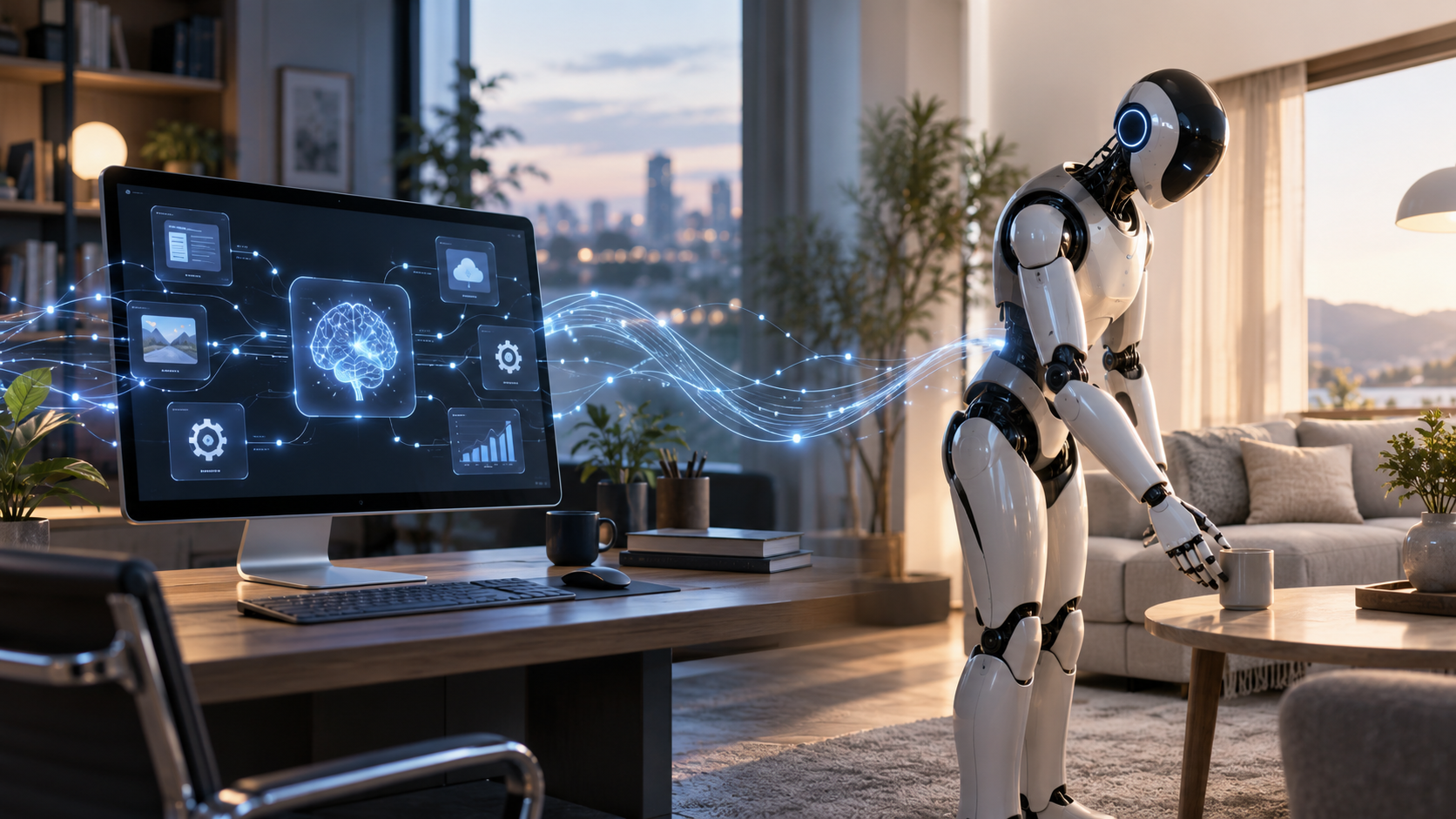
Today, an AI Agent in Your Computer. Tomorrow, a Robot in Your Home: The Second Phase of the AI Revolution
Only a few years ago, artificial intelligence was something most people interacted with through a chat window. You typed a question, waited for an answer, and perhaps used the result to write an email, summarize a document, generate an image or help with a piece of code.
That already felt transformative.
But it may have been only the first phase.
The more important shift happening now is from AI that answers to AI that acts.
Instead of waiting for a person to provide a new instruction every few minutes, an AI agent can be given a goal, access to selected tools and a defined set of permissions. It can then reason through the task, interact with software, analyze information, execute multiple steps and report the outcome.
A customer sends a message at 2:00 a.m. The agent identifies what the customer needs, checks existing account information, updates the customer relationship system, answers a routine question, books an appointment and alerts a human employee if the case requires judgment.
Another agent reviews a business process continuously, discovers an unusual change in performance, gathers the relevant information and prepares an action for approval.
This is where AI automation begins to look very different from the automation businesses have used for years.
But even that may not be the most important change ahead.
Because the intelligence learning to perform work inside software is beginning to acquire something it has never had at scale before:
a body.
The same broad advances that allow an AI agent to understand a goal, plan several steps and interact with digital systems are increasingly being connected to robots that can see, move, manipulate objects and operate in environments originally designed for humans.
That is why the AI agent inside a computer and the humanoid robot entering a factory or home should not necessarily be viewed as two separate revolutions.
They may be two stages of the same one.
The First AI Wave Generated Information. The Next One Executes Work.
Generative AI initially became popular because of its ability to create things.
It could write.
Summarize.
Translate.
Generate images.
Analyze documents.
Assist developers.
Those capabilities dramatically reduced the cost and time required to produce information, but the human remained the primary operator. The person generally decided what needed to happen, prompted the system, reviewed the result and moved the process forward.
Agentic AI changes that relationship.
Instead of giving the system one isolated instruction, a business can give an agent an objective. The agent can identify the steps required, use approved tools, interact with different systems and continue working toward the result.
That distinction matters.
Traditional automation is largely deterministic: when one event occurs, execute a predefined action.
Agentic automation can potentially handle far more context and uncertainty. It can interpret information, choose among permitted actions and adapt the next step based on what happened previously.
This creates an entirely different possibility for businesses.
A company can have one agent supporting customer service, another assisting sales, another analyzing operations, another organizing reports and another coordinating repetitive internal processes.
Then comes the next logical question:
What happens when that intelligence is no longer limited to software?
Physical AI Is Giving Digital Intelligence a Way to Act in the Real World
NVIDIA uses the term physical AI to describe AI systems that understand and act within the physical world.
The challenge is fundamentally different from generating text.
A robot needs to understand space, distance, movement, balance, objects, forces and people. It needs to know that a glass can break, that a person walking through its path should not be hit, and that the location of an object may change from one moment to another.
NVIDIA is building an extensive robotics platform around Isaac GR00T, Jetson Thor, simulation environments and robot foundation models designed for general-purpose humanoids. The company says humanoid robots are particularly attractive because much of the world has already been built around the size, movements and reach of the human body.
That point is easy to underestimate.
Factories, warehouses, hotels, shops, offices and homes are full of stairs, doors, shelves, handles, carts and workstations designed for people.
If a robot can eventually move through those environments using a body roughly compatible with them, companies may be able to introduce automation without rebuilding every physical environment around a specialized machine.
The digital agent and the humanoid therefore solve similar problems at different layers.
One navigates systems. The other navigates the physical world.
NVIDIA Is Already Reimagining the Personal Computer Around Agents
One of the clearest signs that AI agents are moving beyond experimental software came from NVIDIA in 2026.
At GTC Taipei, Jensen Huang asked what the personal computer becomes “in a world of agents.” NVIDIA demonstrated a vision in which personal agents run locally, connect to local or cloud models, operate continuously and complete work in the background.
NVIDIA and Microsoft subsequently introduced RTX Spark, describing a new generation of Windows computers built specifically for personal AI agents. The platform supports local agents and large models, and NVIDIA explicitly describes the shift as moving the computer “from tool to teammate.”
Huang summarized the change simply:
“You ask — and the PC does the work.”
That sentence captures the transition exceptionally well.
For four decades, personal computing largely revolved around people opening applications and operating them manually.
The agent-based model reverses part of that relationship.
Instead of asking, “Which application should I open to complete this task?” the user increasingly asks, “What outcome do I want?” and allows an intelligent layer to coordinate the applications and information required.
NVIDIA now markets RTX Spark systems as machines designed to run personal AI agents 24/7 directly at a desk.
That may become much more important to business automation than another generation of chat interfaces.
An always-available agent can sit above files, calendars, analytics, communication tools and internal systems and continuously participate in work.
NVIDIA is redesigning the personal computer around continuously running AI agents, shifting the PC from a tool people operate into a system that can increasingly perform work for them.
Then the Agent Leaves the Screen
The next step is considerably harder.
Giving an AI system access to software tools is one thing.
Giving it control of a physical machine operating around people is another.
But progress is accelerating.
Google DeepMind introduced Gemini Robotics 2 in July 2026, a new generation of robotics models capable of controlling entire humanoid bodies from feet to fingertips, performing dexterous manipulation and coordinating multiple robots during more complex tasks.
One of the most important advances is not simply movement.
It is reasoning through the task while moving.
Google describes an embodied reasoning model that can observe an environment, develop a plan, coordinate actions, track progress, respond when a step fails and continue through longer sequences involving hundreds of decisions.
That is the bridge between agentic AI and robotics.
Instead of programming every motion in advance, developers are trying to move toward a model in which a person can express an objective and the system determines how to achieve it physically.
Consider the difference between these two instructions.
A traditional industrial robot might effectively be programmed to move its arm to a precise coordinate, close its gripper, rotate a defined number of degrees and place an object at another coordinate.
A general-purpose physical agent could eventually receive something closer to:
“Clean up this room.”
To succeed, it would need to identify the objects, understand where they belong, determine the order of operations, move safely through the room, manipulate different objects and adapt when the environment differs from what it has previously seen.
That is an entirely different class of automation.
Tesla Wants Optimus to Reach Outside Customers in 2027
Tesla is perhaps the most visible example because its ambitions extend well beyond industrial robots.
In January 2026, Elon Musk said Tesla was targeting sales of its Optimus humanoid robot to the public by the end of 2027, assuming the robot reaches sufficiently high levels of reliability, safety and functionality. He also said Optimus robots were already carrying out relatively simple tasks inside Tesla facilities.
The wording matters.
This is a target, not a guaranteed release date.
Tesla has a history of aggressive timelines, and humanoid robotics remains technically difficult. The industry still faces major challenges in dexterity, autonomous reasoning, reliability, battery life, safety and manufacturing economics.
So it would be inaccurate to say that every household will have a Tesla robot in 2027.
But the more significant point is this:
One of the world’s largest technology and manufacturing companies is no longer presenting humanoid robotics purely as laboratory research.
Tesla is publicly discussing a path toward an externally sold product.
Even if the schedule changes, the direction is clear.
A Home Humanoid Robot Can Already Be Ordered
Tesla is not the only company trying to take humanoids beyond factories.
1X has already opened orders for NEO, a humanoid robot designed specifically for the home.
The company offers an early-access ownership option at $20,000 and a $499-per-month subscription model. It says initial deliveries to U.S. homes begin in 2026, with expansion into other markets starting in 2027.
That does not mean NEO is already the fully autonomous household assistant imagined in science fiction.
The company is unusually transparent about the limitation.
NEO arrives with basic autonomy, while more complex tasks can currently involve a scheduled remote expert who supervises the robot and helps it perform or learn the task.
That distinction is important.
A consumer humanoid robot is becoming a real commercial product.
But fully autonomous general-purpose household robotics is still developing.
Both facts can be true at the same time.
And that is precisely what makes the moment interesting.
We are no longer asking only whether a humanoid can exist.
We are starting to ask whether it can become economically useful.
Figure Shows How Quickly the Line Between Demonstration and Deployment Is Moving
Figure provides another useful example because its robots have moved from impressive demonstrations into actual industrial work.
Figure 02 was deployed at BMW’s Spartanburg plant and, according to Figure, operated for more than 1,250 hours, loaded more than 90,000 parts and contributed to the production of more than 30,000 vehicles.
That matters more than a carefully controlled promotional video.
A robot performing a task once is interesting.
A robot operating on a production line every working day generates a completely different type of evidence.
It reveals hardware failures, reliability problems, operational limitations and the economics of deployment.
Figure says the experience with Figure 02 directly informed the design of Figure 03.
Then in June 2026, Figure 03 arrived at BMW for a more complex logistics workflow requiring dynamic whole-body control, including manipulating parts while repositioning its body and pulling a cart.
Meanwhile, Figure has been scaling manufacturing itself.
In April 2026, the company reported that it had produced more than 350 Figure 03 robots and increased manufacturing throughput from roughly one robot per day to one per hour.
This is a critical part of the story.
The humanoid revolution will not happen because a robot can fold a shirt in a video.
It happens when companies can manufacture robots at scale, deploy them repeatedly and improve them using enormous quantities of real-world data.
Humanoid robots are already performing real tasks in factories and logistics operations while the first consumer-focused home robots are beginning to enter the market.
BMW Is Expanding Physical AI Beyond One Factory
BMW is also expanding its experiments.
In March 2026, BMW introduced the AEON humanoid robot into its Leipzig plant in Germany, describing the project as another step in bringing physical AI into real production. The company said the earlier U.S. deployment had already demonstrated useful potential in real production conditions.
This tells us something important about where adoption is likely to begin.
Humanoid robots may first become economically compelling in environments where labor is repetitive, physically demanding, difficult to staff or ergonomically challenging.
The initial winner may not be the robot that makes coffee in a living room.
It may be the robot that reliably moves materials ten hours a day in an industrial facility.
Once the technology becomes safer, cheaper and more capable there, consumer applications can follow.
That pattern is common in technology.
Expensive systems prove themselves in high-value environments first.
Then cost falls.
Capability improves.
And the technology gradually reaches a broader market.
Digit Has Already Moved More Than 100,000 Containers in Commercial Operations
Agility Robotics offers one of the strongest examples of humanoids doing repetitive physical work today.
Its Digit robot has moved more than 100,000 totes in a commercial deployment at GXO’s logistics facility.
Toyota Motor Manufacturing Canada also signed a commercial Robots-as-a-Service agreement with Agility in February 2026 after completing a pilot. The companies plan to use Digit to support manufacturing, supply chain and logistics operations.
The phrase Robots as a Service may prove especially important.
Businesses may not necessarily purchase large fleets of humanoids in the same way they buy traditional industrial equipment.
The commercial model could increasingly resemble cloud software.
Companies pay for access to a capability.
The provider maintains the hardware, software and AI stack.
The robot becomes part of operating expenditure rather than a massive one-time infrastructure project.
Agility is already building a platform for deploying and managing robot fleets, further blurring the line between robotics and enterprise software.
In other words, robots themselves may eventually become another layer of business automation.
Why Is This Happening Now?
Industrial robots have existed for decades.
So why are humanoids and general-purpose robots suddenly receiving so much attention?
Because the mechanical body was never the only problem.
Traditional robots perform extremely well when the task and environment are tightly controlled.
The same robotic arm can repeat a precise movement millions of times.
But the real world is messy.
A box is placed slightly differently.
A person walks across the robot’s path.
A door is closed.
An object falls.
The task changes.
A home may look completely different every morning.
Human environments require perception, language understanding, spatial reasoning, planning, dexterity and adaptation.
Those are exactly the areas in which modern foundation models have advanced rapidly.
NVIDIA is combining robot foundation models, simulation, onboard computing and training infrastructure through Isaac GR00T.
Google DeepMind is connecting vision, language, embodied reasoning and motor control through Gemini Robotics.
Figure is collecting increasingly large volumes of real-world physical data from humanoid fleets.
The race is therefore no longer only about building better hardware.
It is about building the intelligence layer that makes general-purpose hardware useful.
The intelligence that matured inside the screen is beginning to acquire a body.
What Does Any of This Have to Do With Business Automation Today?
This is where the subject becomes relevant even to a company that has no intention of purchasing a humanoid robot.
The automation transition begins long before the robot arrives.
A company can already allow an AI agent to receive a customer inquiry, understand the request, classify it, retrieve relevant information, update a customer record, schedule an appointment, generate a follow-up and escalate the conversation when human judgment is required.
The same concept applies to internal operations.
Agents can gather information across systems, prepare reports, track repetitive processes, monitor workflows and assist employees with actions that previously required moving manually between multiple applications.
This is AI automation today.
Physical AI is simply the extension of the same logic into environments where work includes movement.
Imagine an ecommerce order.
The digital agent receives the order and verifies the information.
The business systems process it.
A physical robot eventually collects or moves the product.
Another automated system prepares logistics.
The distinction between “software automation” and “physical automation” begins to disappear.
The entire process becomes one connected workflow.
A Business That Cannot Organize Its Digital Processes Will Not Be Saved by a Robot
There is also a less glamorous lesson in all of this.
Businesses should not wait for humanoid robots while leaving their current operations disorganized.
A robot does not magically fix a broken process.
Neither does an AI agent.
If customer information is scattered across personal messages, spreadsheets and disconnected platforms, if employees follow different undocumented procedures, and if no one knows which actions require approval, adding AI can simply automate confusion.
Sometimes it makes the confusion faster.
The businesses most prepared for the next stage will be those that begin organizing their operating systems today.
That means connecting data.
Defining workflows.
Structuring knowledge.
Clarifying permissions.
Identifying repetitive tasks.
Creating approval boundaries.
Deciding what an AI agent can execute autonomously and what must remain under human control.
These are the foundations of AI automation.
The same foundations will matter even more when digital decisions begin producing physical actions.
Will Humanoid Robots Replace Human Jobs?
That is the question most headlines eventually reach.
The answer today is more complicated than either extreme.
Robots are already performing real commercial tasks.
But humanoid robotics is nowhere near universal human-level capability.
Reuters reported in August 2026 that even China’s rapidly expanding humanoid industry still faces significant limitations in dexterity, autonomy, adaptability and the ability to perform useful factory work consistently. Many demonstrations remain choreographed or require much more controlled conditions than normal workplaces provide.
That reality should be part of any serious discussion.
The technology is moving quickly.
It is also still difficult.
The first deployments are therefore likely to continue targeting repetitive, physically demanding, dangerous or difficult-to-staff tasks.
NVIDIA similarly frames general-purpose humanoids around existing human-centric industrial spaces and repetitive or demanding work rather than immediate wholesale replacement of every human role.
Over time, the important question may shift from:
“Will robots replace people?”
to:
“Which activities should be performed by people, which by agents, which by specialized machines and which by general-purpose robots?”
That is a more useful business question.
2027 Will Not Put a Robot in Every Home
The next two years will probably produce dramatic headlines.
Tesla is targeting external Optimus sales.
1X is delivering early home robots.
Figure is increasing production.
Google and NVIDIA are building increasingly capable physical AI systems.
Agility is expanding commercial deployments.
But that does not mean the average household wakes up in January 2028 with a humanoid assistant in the kitchen.
Several problems remain difficult.
Dexterity.
Safety.
Battery life.
Manufacturing cost.
Reliability.
Privacy.
Regulation.
Long-term maintenance.
And perhaps most important: economics.
A robot must not simply be technically capable of performing a task.
It needs to perform that task reliably enough, often enough and cheaply enough to justify deploying it instead of a human or a simpler specialized machine.
That threshold will be reached at different times for different use cases.
Factories and warehouses may come first.
Then selected service environments.
Then higher-income early consumer markets.
Eventually, if costs fall and capability rises, the technology can become mainstream.
The Definition of a Worker May Be About to Expand
There is a broader implication that businesses should begin considering.
Traditionally, operational capacity came primarily from people and machines.
Software then became another layer.
But software remained largely a tool that people operated.
Agentic AI introduces something different.
A software system that can perform meaningful work.
Physical AI introduces another layer.
A machine that can interpret a goal and perform work in the physical environment.
The future workforce may therefore be a mixture of:
humans,
traditional software,
AI agents,
specialized automation,
and general-purpose robots.
The key business metric may gradually become less about the raw number of employees and more about the amount of operational capability the organization can create.
A company with 50 people and a sophisticated AI automation layer could potentially execute work very differently from another company with 50 people but entirely manual systems.
Add physical automation later and the difference grows again.
This is not simply a technology upgrade.
It is a change in operating model.
And Humans Will Not Manually Operate Every Agent and Every Robot
If a humanoid robot requires a dedicated employee to remotely control every movement, the economic benefits of automation become limited.
The real race is therefore about autonomy.
The system must increasingly be able to observe.
Understand.
Plan.
Act.
Verify the result.
Recover from certain failures.
And recognize when it should stop and ask a person.
These are remarkably similar to the capabilities required by sophisticated digital agents.
The environment is different, but the logic overlaps.
A customer-service agent may need to decide which system to access next.
A physical agent may need to decide which object to move next.
Both require context.
Both require planning.
Both require permissions.
Both require monitoring.
And both require governance.
The physical world simply makes mistakes far more expensive.
A software agent can sometimes undo a digital action.
A robot interacting with people, products or machinery may not have that luxury.
That is why safety, observability and human control will become central components of AI automation.
From Digital Autopilot to Business Autopilot
For years, businesses used the phrase “autopilot” loosely.
A scheduled email could be called automation.
An advertising rule could be called autopilot.
A simple customer-service chatbot could be called AI.
The systems now emerging are much more ambitious.
A company can increasingly create an intelligent layer that works across multiple business systems and participates continuously in operations.
Then physical AI expands that layer into the real world.
A process might begin digitally.
The decision might be made digitally.
The final action might eventually happen physically.
That is why businesses should not view AI automation simply as a way to save a few administrative hours.
It is becoming the foundation for a fundamentally different operating architecture.
The companies learning today how to connect systems, structure data, grant controlled permissions and supervise AI agents will be far better prepared for the next stage.
Do Not Wait for the Robot
A fully capable, affordable household humanoid may still be years away.
That does not mean businesses should wait.
The first layer already exists.
Customer inquiries can already be classified intelligently.
Sales systems can already be connected.
Reports can already be produced and analyzed automatically.
Repetitive processes can already be orchestrated.
AI agents can already work inside defined boundaries and escalate decisions that require human judgment.
The question businesses should ask today is therefore not:
“When can I buy a humanoid robot?”
The better question is:
“How much of my business could already operate intelligently and automatically today?”
Because the distance between an AI agent inside a computer and a robot performing physical work may be shorter than it appears.
First, we gave AI language.
Then we gave it tools.
Then we gave it the ability to reason through tasks and take actions.
Now the industry is beginning to give it a body.
Today, an AI agent in your computer. Tomorrow, a robot in your home.
The second phase of the AI revolution has already started.
FAQs
What is an AI agent?
An AI agent is a system that can work toward a goal rather than simply return one answer. Depending on its permissions, it can reason through multiple steps, use connected tools, retrieve information, execute actions and continue until the task is completed or requires human approval.
What is the difference between AI automation and physical AI?
AI automation usually operates within digital systems such as customer service, sales, reporting, data analysis and internal workflows. Physical AI connects intelligent models to robots and machines so they can perceive, reason and act in the physical world.
Is Tesla Optimus really going on sale in 2027?
Elon Musk said Tesla is targeting public Optimus sales by the end of 2027 if the robot reaches the required levels of reliability, safety and functionality. It should therefore be treated as a company target rather than a guaranteed launch date.
Can consumers already buy a humanoid home robot?
1X currently accepts orders for its NEO home robot, with U.S. deliveries beginning in 2026 and expansion to additional markets planned from 2027. The product is still evolving, and some more complex tasks may involve scheduled remote expert supervision.
Are humanoid robots already working in factories?
Yes. Figure 02 operated at BMW’s Spartanburg plant and contributed to the production of more than 30,000 vehicles, while Agility Robotics’ Digit has moved more than 100,000 totes in a live commercial logistics deployment.
What is NVIDIA’s role in humanoid robotics?
NVIDIA provides computing platforms, simulation tools, robot foundation models and development infrastructure through technologies such as Isaac GR00T and Jetson Thor. Its ecosystem is being used by robotics companies and industrial manufacturers developing physical AI systems.
Should businesses wait for humanoid robots before investing in AI automation?
No. Businesses can already automate digital workflows, connect customer and sales systems, build AI agents, structure knowledge and reduce repetitive work. These foundations will also make it easier to adopt more advanced forms of automation later.
Related AI Automation Articles
Explore more articles about artificial intelligence, automation, smart marketing systems, and digital transformation.